


- First Steps Checklist
-
Frequently Asked Questions
-
All About Features
- How to Install the Tracking Code
-
User Guides
-
Integrating With Other Platforms
-
Legal, Data Privacy & Certificates
- TWAIA Addendum
- White Label Analytics
- Glossary
- Contact
Surveys
Gather In-Depth Visitor Insights
What It's All About
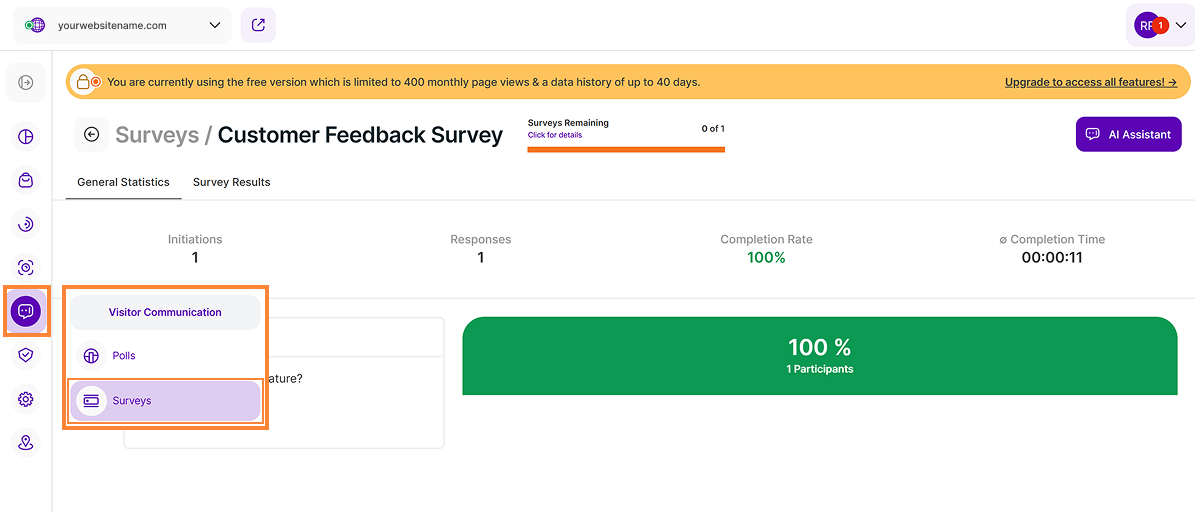
The second feature within the Visitor Communication module is Surveys. Surveys are dedicated-page questionnaires hosted on a separate URL rather than being embedded directly on your site like polls. This makes them versatile enough to be shared across any digital channel, including email and social media, and ideal for longer or more complex inquiries.
From this module, you can create, edit, and manage your surveys while gaining deep insights into both overall performance and individual participant responses.
Some General Hints
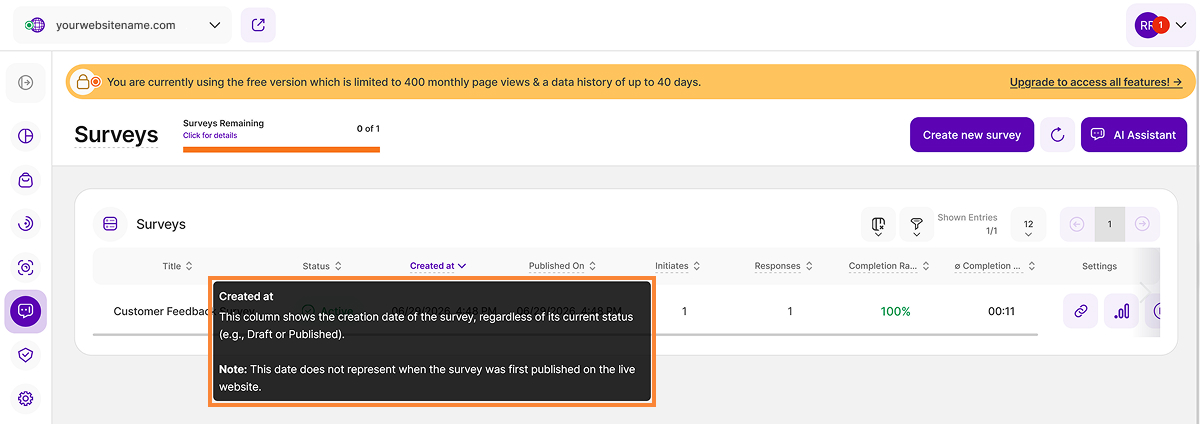
These tips will help you discover hidden information and get the most out of this module to analyze your dashboard data:
- Plan Limits: Click on the feature counter (Click for details) to display a tooltip showing your current plan's limits. Click the Increase your limits button within the limits tooltip to access the Upgrade Plan option.
- AI Assistant Button: Our new assistant, TWAIA, is located in the top right corner of all modules. This gives you easy, one-click access to assistance whenever you need it.
- Tooltips: You can access the tooltips containing full column titles, descriptions, helpful hints, and glossary links by clicking on Page headers, Report Block (RB) titles, and Section headers. These titles are displayed for all languages. For tabs, the tooltip is available only if the tab is currently active. Hint: Look for a dashed underline on clickable elements to identify those with tooltips.
- Hover Functionality: Simply move your mouse over certain elements to instantly view more information.
- Display Order: Polls and surveys are displayed on your live site in the order they were originally created. This sequence remains consistent even if items were initially saved as drafts, paused, or rearranged in your internal list.
How to Activate Surveys
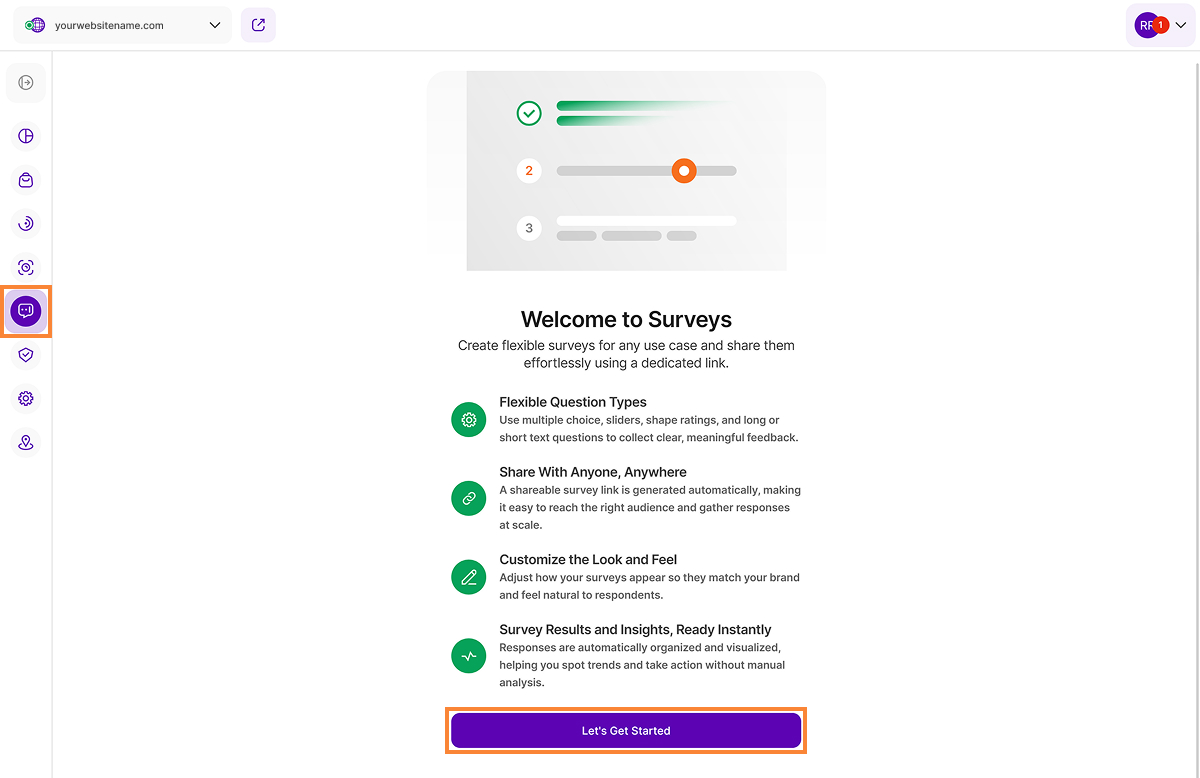
To activate the Surveys feature, please follow these steps:
- On the Main Menu, locate and click on Visitor Communication, then select Surveys.
- On the Welcome screen, click the Let's Get Started button to initiate the setup process.
- Configure your questions, adjust your settings and set up your design theme.
- Click the Publish button in the top right corner to begin gathering insights immediately.
Once your surveys are configured and published, you can start sharing the survey link to collect data.
Creating a Survey
To create an engaging survey for the right audience, the setup process is divided into four main sections. To begin, click Let’s Get Started on the Welcome Screen or select Create New Survey, then complete the following steps:
As you configure your survey, a live preview is displayed on the right side of the screen. This allows you to see your changes in real time while making adjustments in the configuration panel on the left.
Question Creation
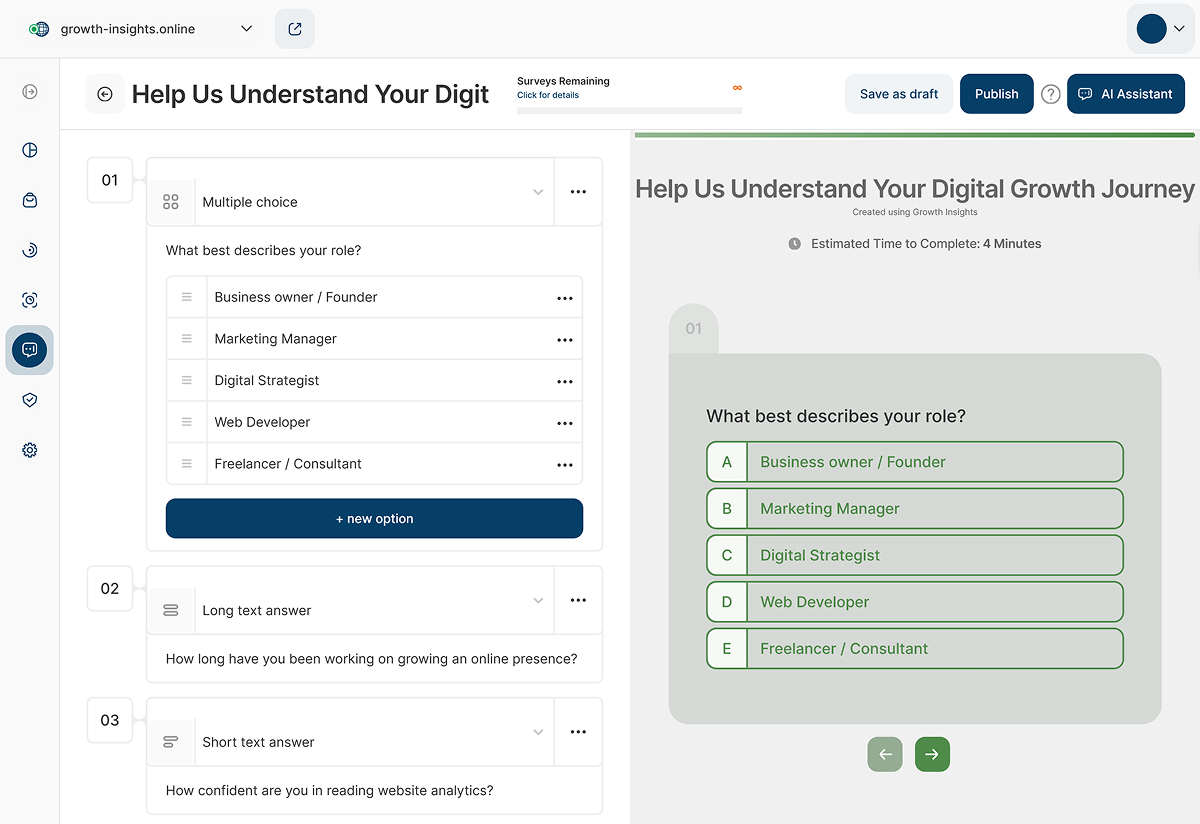
To ensure your survey creation process is as straightforward as possible, we have included a question creator with several pre-defined question types. Start by creating a survey title that captures your visitors' attention and clearly explains the purpose of the survey.
You can add an optional description to each question to provide further context. Familiarizing yourself with these formats will help you select the best structure for your goals. Each survey supports a maximum of 65 questions, allowing you to collect precise, actionable data.
Below are the available question types:
- Short Text Answer: Best for brief responses. This type includes a text question and an optional description with a character limit of 280 characters.
- Long Text Answer: Ideal for detailed feedback. This option allows for more extensive text replies with a limit of 4,000 characters.
- Multiple Choice: Define a specific set of choices for your participants. Each option can be named individually, and you can include a description for additional context. The Allow multiple markings option is also available, allowing participants to select more than one choice per question.
- Slider: Participants provide feedback by moving a slider across a scale. You can customize the labels that appear on the slider to guide the participant's response.
- Shape Rating: This type allows you to use pre-defined shapes instead of numbers for your rating scale, such as stars, hearts, or thumbs up. You can define both the number of steps and their labels.
- Numerical Rating: Define a numerical scale with custom labels and set the number of steps as needed.
- Email: Designed specifically for collecting email addresses from participants.
- Phone Number: Allows you to collect participants’ phone numbers, including country codes, to ensure accurate contact information.
- Website address: Enables you to collect the participant’s website address for accurate reference.
- Date: Best suited for questions that require a specific calendar date, such as scheduling an event.
To add your first question, select the desired type from the dropdown menu. To add subsequent questions, click the + New Question button and repeat the process.
Important Notes:
- Additional settings are available next to the question type dropdown. Click the three-dot icon (...) to move, duplicate or delete a question.
- Participants must answer each question before they can proceed to the next one.
Settings
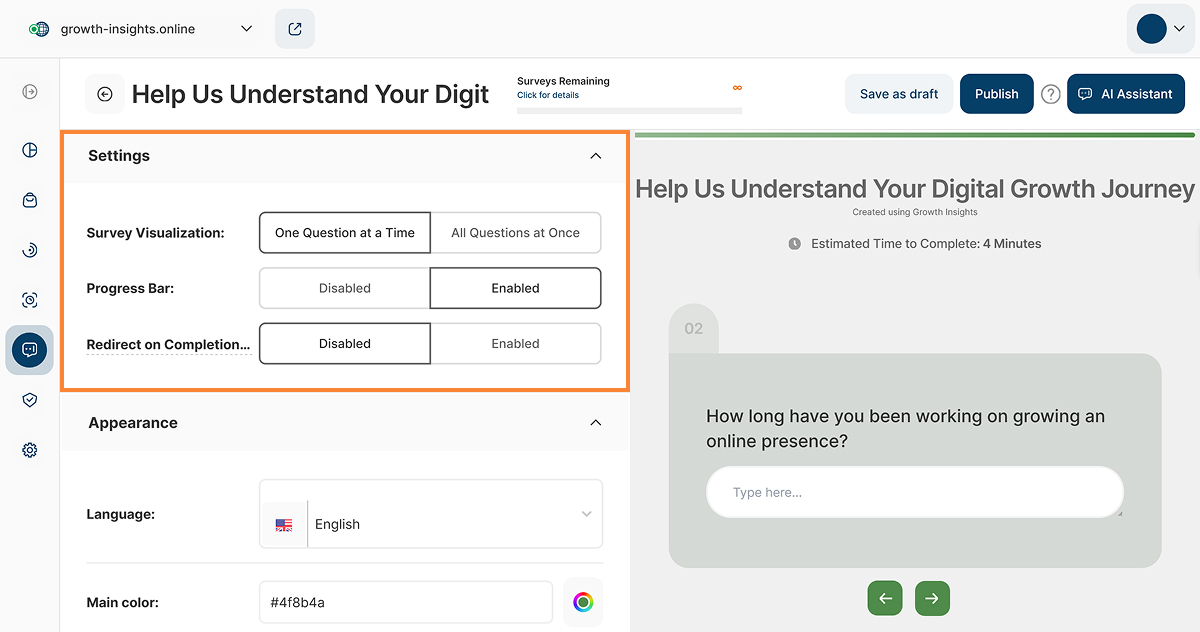
Optimize your data collection by adjusting your survey settings to better suit your participants’ experience. You can configure the following options:
- Survey Visualization:Choose how your survey is presented to your audience. Select One Question at a Time to display a single question per screen, which helps maintain focus and reduce participant fatigue. Alternatively, choose All Questions at Once to display the entire survey on a single page, which is ideal for shorter surveys.
- Progress Bar: The progress bar helps participants see how much of the survey they have completed. Select Disabled to hide the progress bar, or choose Enabled to display it to participants, providing a clear visual indicator of their progress.
- Redirect on Completion:You can automatically redirect respondents to a specific URL after they submit their survey, such as a thank-you or voucher page. Select Disabled to keep the survey on the submission page upon completion, or choose Enabled to automatically redirect participants to your chosen URL immediately after they complete the survey.
Appearance
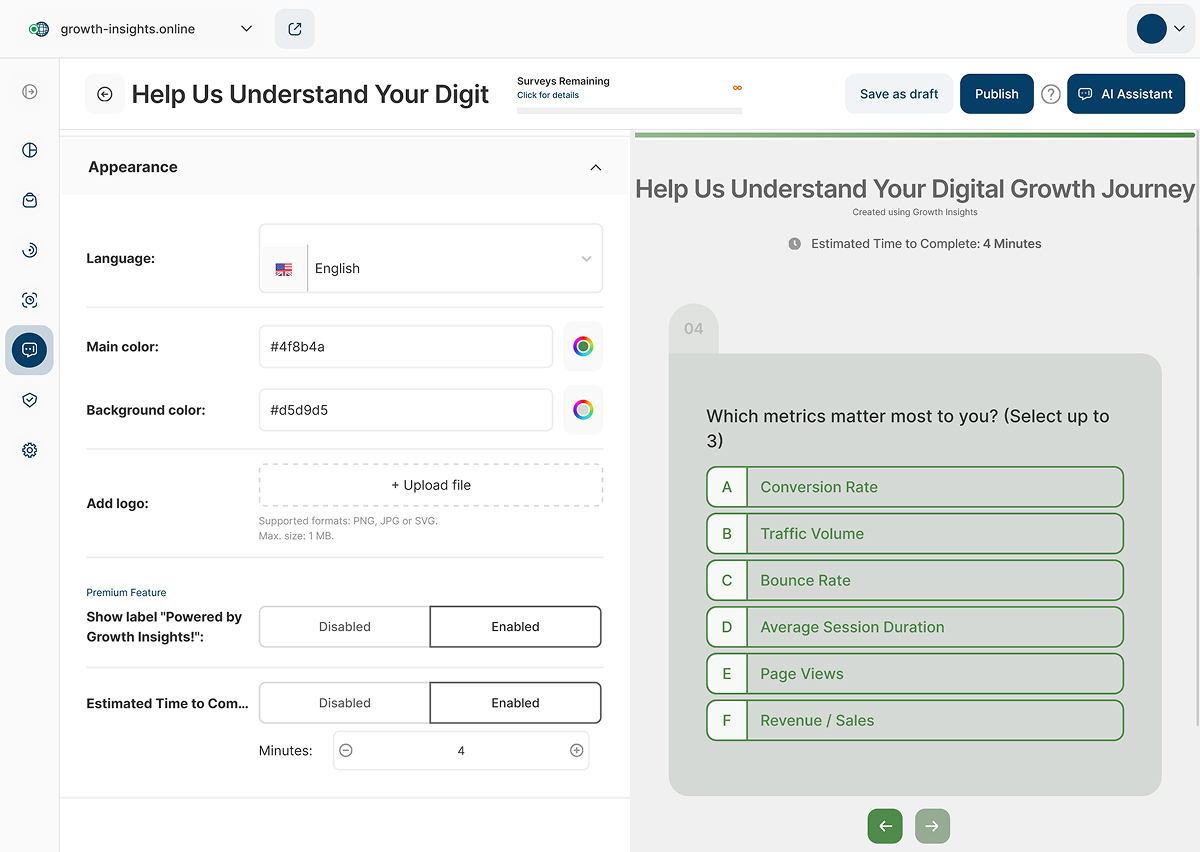
Our platform provides a wide range of customization options to ensure your surveys align perfectly with your brand identity. By tailoring various design elements, you can create a seamless and engaging experience for your audience.
Here is how to customize the appearance of your surveys:
- Language: Customize your survey language by selecting one of the pre-defined options such as English, German, Romanian, and more.
- Main color: Choose a primary color that matches your website and brand identity. You can enter a hex color code manually or select a shade using the color picker.
- Background color: Select a background color that complements your main color. You can enter a hex code or utilize the color picker to find the perfect shade for your theme.
- Add logo: To further personalize your survey, you can upload a custom logo to display at the top. Please ensure your file is in PNG, JPG, or SVG format and does not exceed 1 MB.
- Show label “Powered by..” Premium Feature: Choose whether to display this label on your published survey. Enabling this option adds the branding label to your survey, while disabling it removes the label for a cleaner, white-labeled experience. This feature requires a minimum pricing plan.
- Estimated Time to Complete: Provide participants with an estimate of how long the survey will take, and define the duration in minutes.
Publish
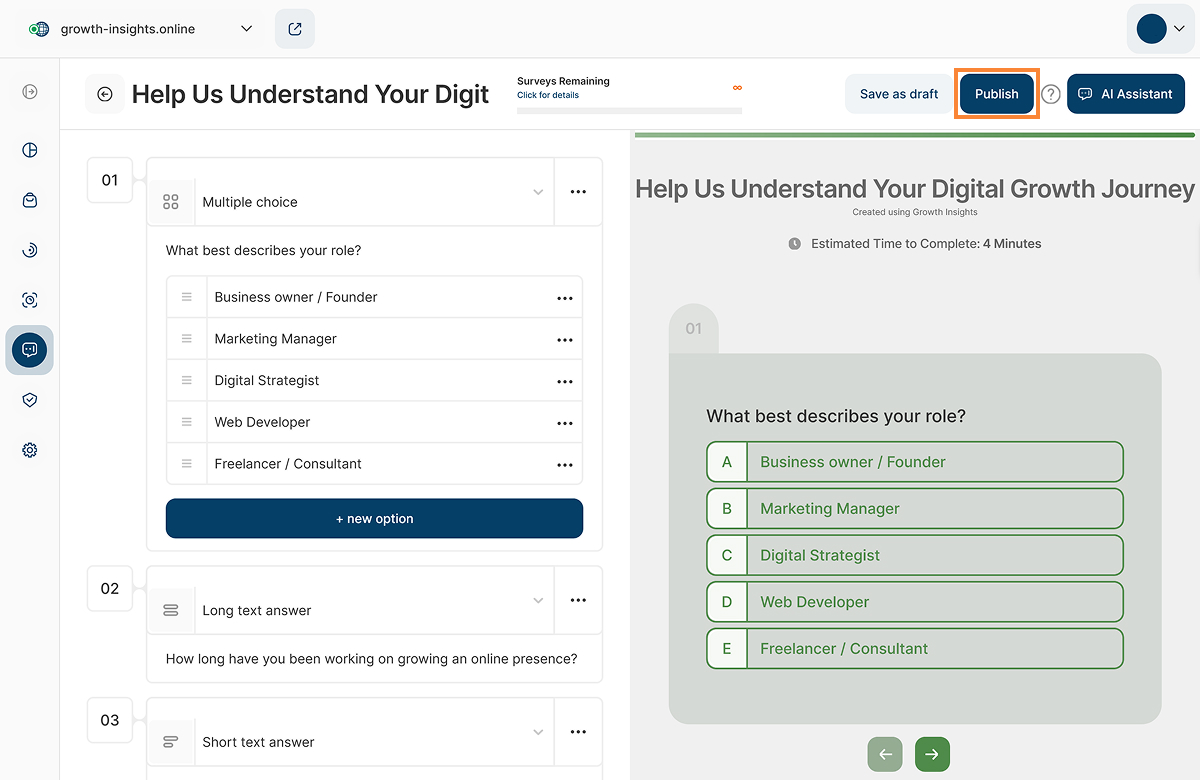
Once you have finished creating your survey questions, configured the Settings, and customized the Appearance, you are ready to make your survey available to participants. To do so, click Publish in the upper-right corner of the page.
If you are not ready to publish your survey, click Save as Draft instead. This saves your progress so you can return later to continue editing or complete the survey setup before publishing.
After your survey has been published, return to the main survey table and click Share Survey to copy the survey link and distribute it to your target participants.
Important Note: Once a survey has been published, its questions and survey settings can no longer be modified. Be sure to review all questions, settings, and appearance options carefully before publishing.
Main Table of Surveys
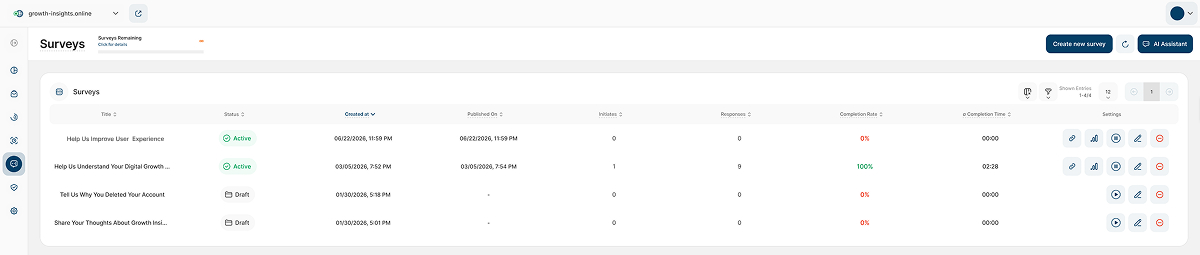
Once a survey is created, it is automatically added to the main table, which displays all surveys regardless of their current status. The table includes the following columns:
- Title: This shows the custom title you have set for the survey.
- Status: Indicates whether a survey is Active, Inactive, Paused, or saved as a Draft.
- Created at: This column shows the creation date of the survey, regardless of its current status (e.g., Draft or Published). Note: This date does not represent when the survey was first published on the live website.
- Published On: This column displays the date each survey was published.
- Initiates: This column displays the total number of participants for each survey, including both "initiators" and those who have "fully completed the survey." Initiators are users who started the survey by answering at least one question but did not complete all questions. They are not counted as fully completed participants.
- Responses: This column shows the total number of answers given by all participants across all questions. Note: A single participant may answer multiple questions, so the number of responses may exceed the number of participants.
- Completion Rate: This column shows a survey's overall completion rate of its participants. It is calculated as: (Number of participants that fully completed survey) / (Total Number of survey initiators). Note: The completion rate cannot be determined until at least one participant has completed the entire survey.
- ∅ Completion Time: This column shows the average completion time for a survey's participants. Note: The time cannot be determined until at least one participant has fully completed the survey.
Settings: Allows you to access additional actions actions and management options, including:
- Share Survey: Copies the survey link to share it with participants.
- View stats for this survey: Open the survey analytics dashboard to review participant responses and performance metrics.
- Pause survey: Temporarily pause the survey from accepting new responses without deleting it. To resume collecting responses, click the Activate survey button again to reactivate the survey.
- Edit/View survey: Open the survey to view its details or make changes (if the survey is still unpublished).
- Delete survey: Permanently remove the survey and all associated data from your account.
Survey Statistics and Analysis
After clicking View stats for this survey from the main table, you are taken to the survey's detailed statistics page. This page contains two tabs that provide comprehensive insights into your survey's performance, participant engagement, and responses:
General Statistics
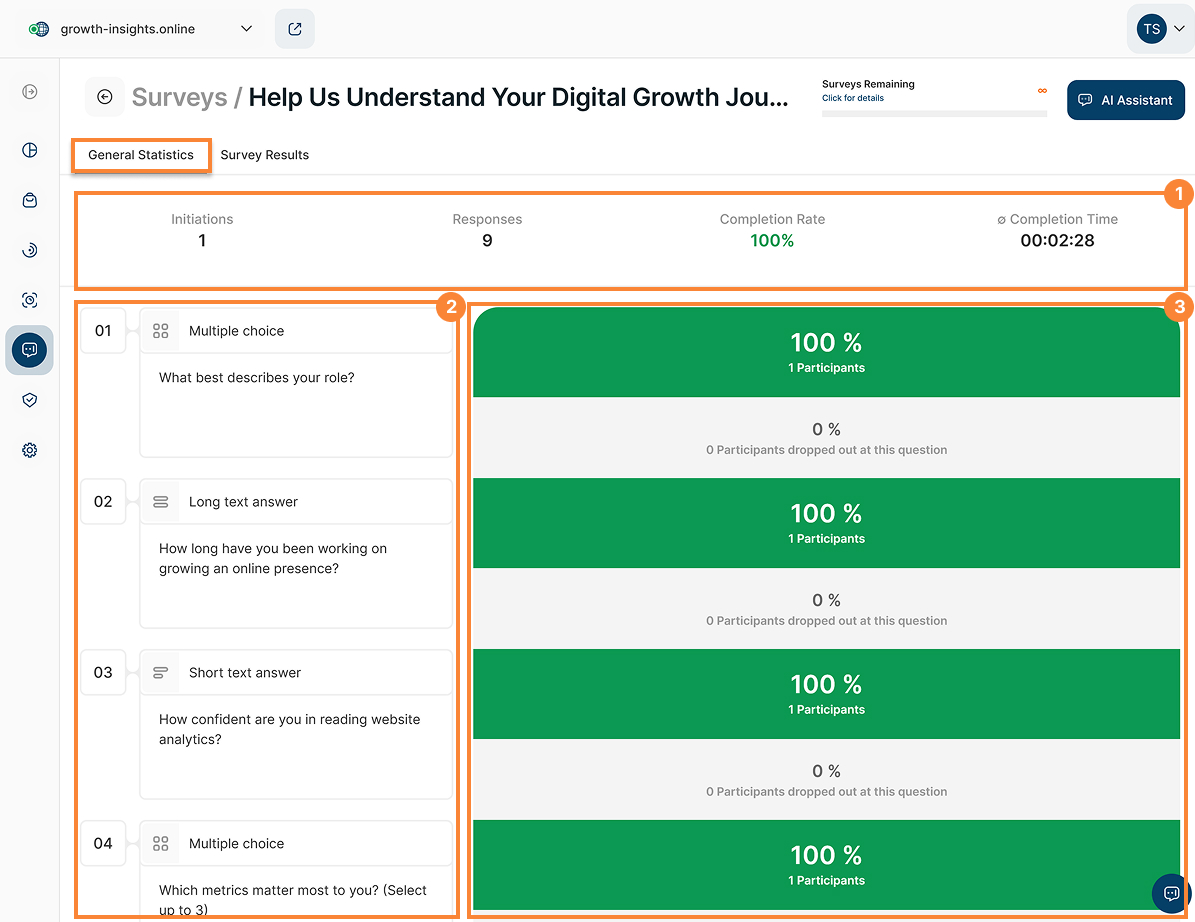
The General Statistics tab provides a detailed view of your survey's performance. It is divided into three main sections that work together to give you a comprehensive understanding of participant engagement and survey effectiveness.
The top section (1) displays a summary of the survey's Key Performance Indicators (KPIs), providing a quick overview of its overall performance:
- Initiations: Displays the total number of participants who engaged with the survey. This metric includes both initiators and completed participants. Initiators are participants who started the survey by answering at least one question but did not complete all questions. Completed participants are those who answered all questions and successfully finished the survey.
- Responses: Shows the total number of responses or answers given by all participants to all questions.
- Completion Rate: Displays the completion rate which is calculated for all participants. It cannot be fully determined until at least one participant has fully completed the survey.
- ∅ Completion Time: This metric displays the average time taken by all participants to complete the survey.
Directly below the Key Performance Indicators (KPIs), the page is divided into two sections. On the left, the Question Details (2) section displays information for each survey question, including the question number, question type, and the full question text. This information provides the context needed to identify the question being analyzed and interpret its corresponding performance metrics.
On the right is a funnel (3) section. It provides a visual representation of participant progression for each survey question. It displays the percentage and number of participants who completed the question, as well as those who dropped out at that point in the survey. This makes it easy to evaluate participant engagement, identify where respondents exited the survey, and pinpoint questions that may require improvement to increase completion rates.
The funnel analysis uses color-coded indicators to represent the completion rate for each question. Green indicates a high completion rate, yellow indicates a moderate completion rate, and red indicates a low completion rate. These visual indicators make it easy to identify questions where participants are more likely to abandon the survey, helping you optimize your survey to improve engagement and increase completion rates.
Survey Results
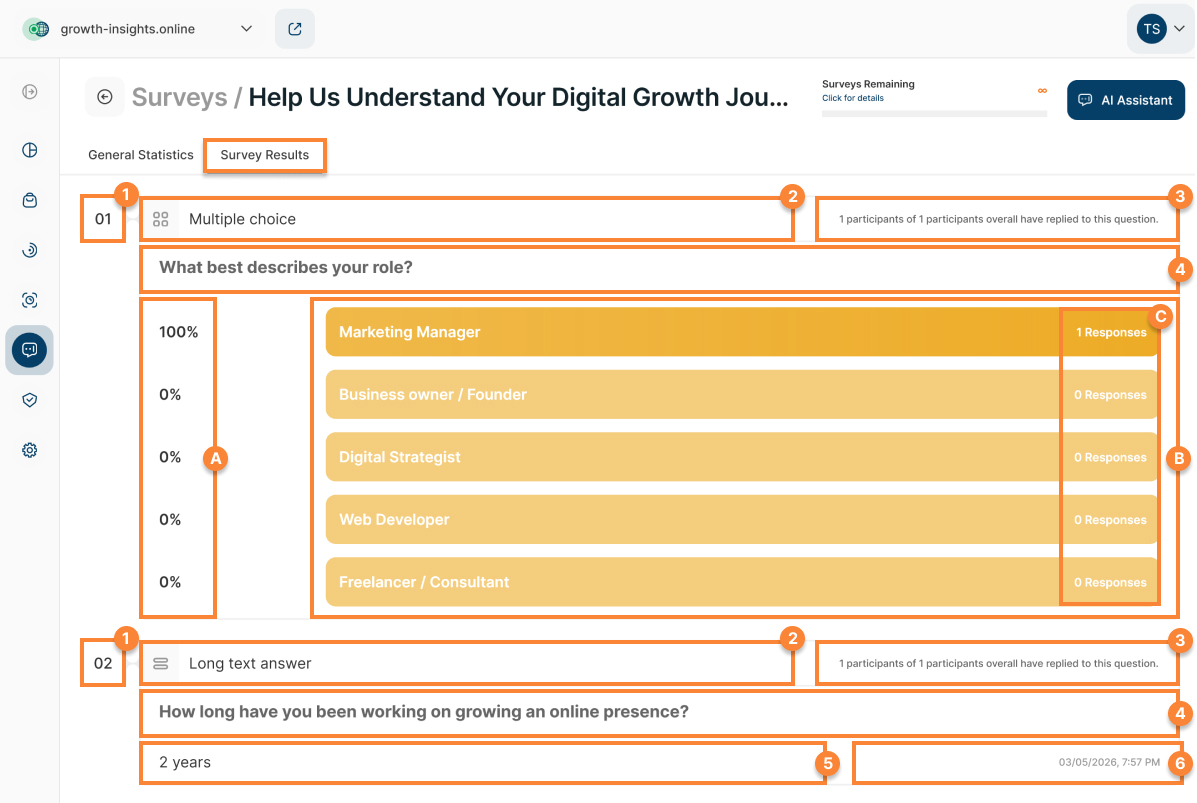
The Survey Results tab provides a detailed breakdown of responses for each survey question, allowing you to analyze participant feedback more effectively. By reviewing these results, you can identify response trends, understand participant preferences, and make informed decisions based on the collected data.
The following details are displayed in this section:
- Question Number: Each question is assigned a unique number, allowing you to easily identify its position within the survey.
- Question Type: Displays the type of question (e.g., Short Text Answer, Multiple Choice, or Long Text Answer) next to the question number.
- Participant Count: Shows the number of participants who answered the question, along with the total number of participants who took part in the survey.
- Question: Displays the full text of the question.
- Answers: Displays the responses submitted for the survey question.
- Completion Date: Shows the date and time when the participant has completed or submitted the poll.
For Multiple choice, Slider, Shape rating, and Numerical rating questions, the following response statistics are displayed to help you compare answer distributions:
A. Percentage: Shows the percentage that each answer option represents out of all responses received for that question, with the highest percentage displayed at the top for easier comparison and analysis.
B. Answer Options: The answers are sorted in descending order by number of responses received.
C. Response Count: Displays the total number of responses received for each answer option.
Important Note: Response results for questions with multiple answer options are displayed using horizontal bars, which provide a visual representation of each answer option's share of the total responses. Longer bars indicate that an option was selected more frequently, making it easier to identify trends and compare results at a glance.
