- TL;DR
- What a text watermark actually is
- What the EU AI Act actually asks of you
- The exemption is real, but the bar is higher than people think
- The SEO fear, and why it is the wrong fear
- Where a grounded, human-edited workflow stands
- What this looks like for a legal team
- The compliance question, answered before it is asked
- More on Growth Engine
AI Watermarks, the EU AI Act, and the Content Compliance Question Nobody's Asking Yet
The rules are written, the watermarks are live, and the exemption most teams are counting on is harder to earn than it looks.
This article explains the rules as we understand them and how TWIPLA's workflow relates to them. It is not legal advice. Check your own obligations with a qualified adviser.
In the second half of 2026, three things happened that most content teams have not connected yet.
On 2 August, the transparency rules in Article 50 of the EU AI Act started to apply, with a final Code of Practice and Commission guidelines explaining what they mean. In August, Anthropic began watermarking text from its Claude models worldwide. On 5 October, OpenAI switched on watermarking for ChatGPT in the EU. Put those together and the picture changes: the AI-generated text your team publishes is becoming detectable, and there are now specific rules about when and how to disclose it.
If your workflow is "paste a prompt into a chatbot, copy the answer into the CMS", that is a problem you have not priced in yet. If it is grounded in your own data and run by an editor who actually edits, it is mostly already solved. Here is why.
TL;DR
Text watermarks live in the words themselves, so they survive copy and paste but fade with editing. Article 50 asks you to label AI-generated text on matters of public interest, unless a competent person has substantively reviewed it and holds editorial responsibility, and the final guidelines make clear that a spell-check does not count. Google does not penalize AI content, only thin, mass-produced content. All three point the same way: content grounded in your own audience and properly edited by a named person is safe on every front. Growth Engine, TWIPLA's content tool, is built that way: every draft starts from a gap your own visitors have already shown you, not from a prompt. Any AI writing tool can add a human editor. Only one that sits inside your analytics can start from your own data. Every draft then has an owner and passes through that person in the editor before it goes anywhere.
What a text watermark actually is
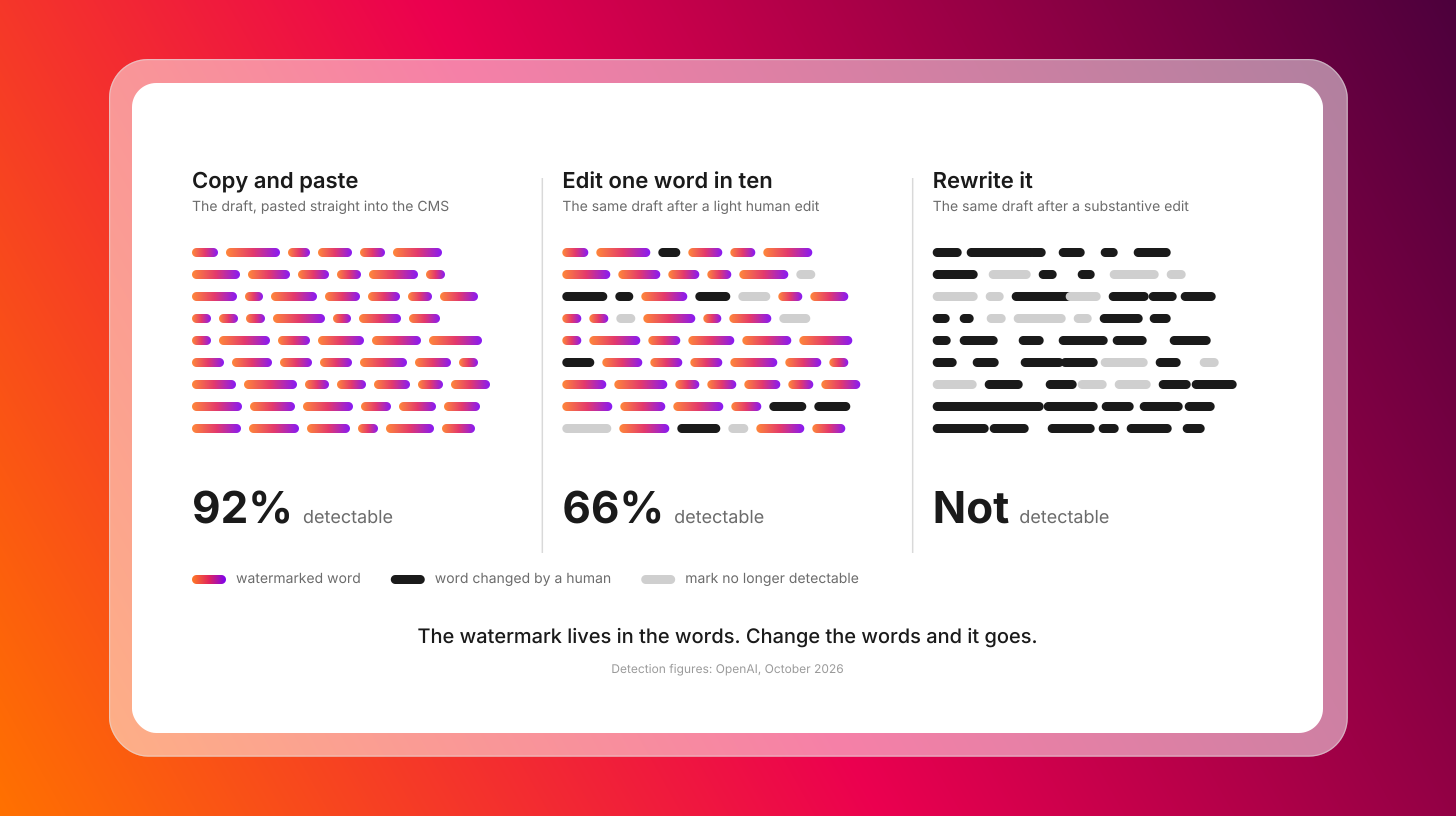
Watermarking text is not like watermarking an image. There is no logo, no metadata field, nothing a CMS strips out on upload. Instead, when a language model chooses between equally good words, a cryptographic key nudges the choice. Across a few hundred words the nudges add up to a statistical pattern that a detector with the key can recognize, and a human reader never will.
That has two consequences worth knowing. First, copy and paste does not remove it. The pattern lives in the words themselves, so a raw draft pasted into WordPress carries the mark onto the published page. Second, the mark is fragile. OpenAI's own figures show that swapping one word in ten for a synonym cuts detection from about 92% to 66%, and Anthropic says its mark disappears in a full rewrite. Heavy human editing dilutes it toward nothing.
As of October 2026, Anthropic marks Claude's output everywhere, and OpenAI marks ChatGPT output for EU users. Neither detector is public yet; both are going to regulators and researchers first. Assume that window widens.
What the EU AI Act actually asks of you
Article 50 puts duties on two groups.
- Providers of AI systems (the model companies) must mark their outputs in a machine-readable way. That is what the watermarks are for.
- Deployers, meaning you, the business using the AI, have a narrower duty: if you publish AI-generated text "with the purpose of informing the public on matters of public interest", you have to disclose that it was artificially generated.
The Commission's guidelines narrow that further, and the narrowing matters for marketers.
Public interest means topics "relevant to society at large": public health, consumer safety, the environment, finance, democratic processes. AI-written news summaries, investor reports and health or sustainability claims are in scope. Product descriptions, advertising and fiction are out. So a product page written with AI does not need a label. A blog post making factual claims about data privacy, or a guide to a regulation, probably does.
Then comes the part that matters most. The disclosure duty does not apply where the content has been subject to human review or editorial control, and a natural or legal person holds editorial responsibility for its publication.
Read that again, because it is the whole game. The regulation is not trying to stop you using AI to write. It is trying to stop unreviewed machine output being passed off as the considered word of a publisher.
The exemption is real, but the bar is higher than people think
The guidelines, published on 20 July 2026, say what counts as human review, and it is not a formality.
Review must be "deliberate substantive examination" by a competent person, or control by an editorial function that can approve, change or reject content on its substance. Fact-checking is the minimum. Spell-checking, grammar correction and automated checks do not qualify. The person with editorial responsibility must be publicly identifiable. And, the detail most teams will miss: if the AI makes a substantive edit after the human review, the exemption can be lost. The human pass has to be the last one.
For a team that pastes chatbot output into a CMS and hits publish, none of that is in place. For a team that treats AI drafts as drafts, it describes what they already do.
If you do need to label, the format is set too: the EU's "AI GENERATED" or "AI MODIFIED" icon, or an equivalent text label, placed at the top of the piece near the headline, not buried at the end. Nothing published before 2 August 2026 needs labeling retroactively.
The SEO fear, and why it is the wrong fear
The first question most marketers ask is: if Google can detect the watermark, will my rankings suffer? No. Google judges content on quality, not on how it was produced, and what it penalizes is scaled content abuse: mass-produced pages that exist to game rankings rather than help anyone. A watermark is not a ranking signal. Thin, generic content is, and always was.
So the real exposure is not “Google finds out I used AI”. It is “I published a lot of undifferentiated AI text that nobody edited”, which is exactly the content Google’s spam systems target, and exactly the content Article 50 wants labeled.
Where a grounded, human-edited workflow stands
Look at those two risks side by side and they have the same cure: content that is specific to your audience and that a competent human has taken responsibility for. That is what Growth Engine is built to produce, and it does so by design rather than by policy.
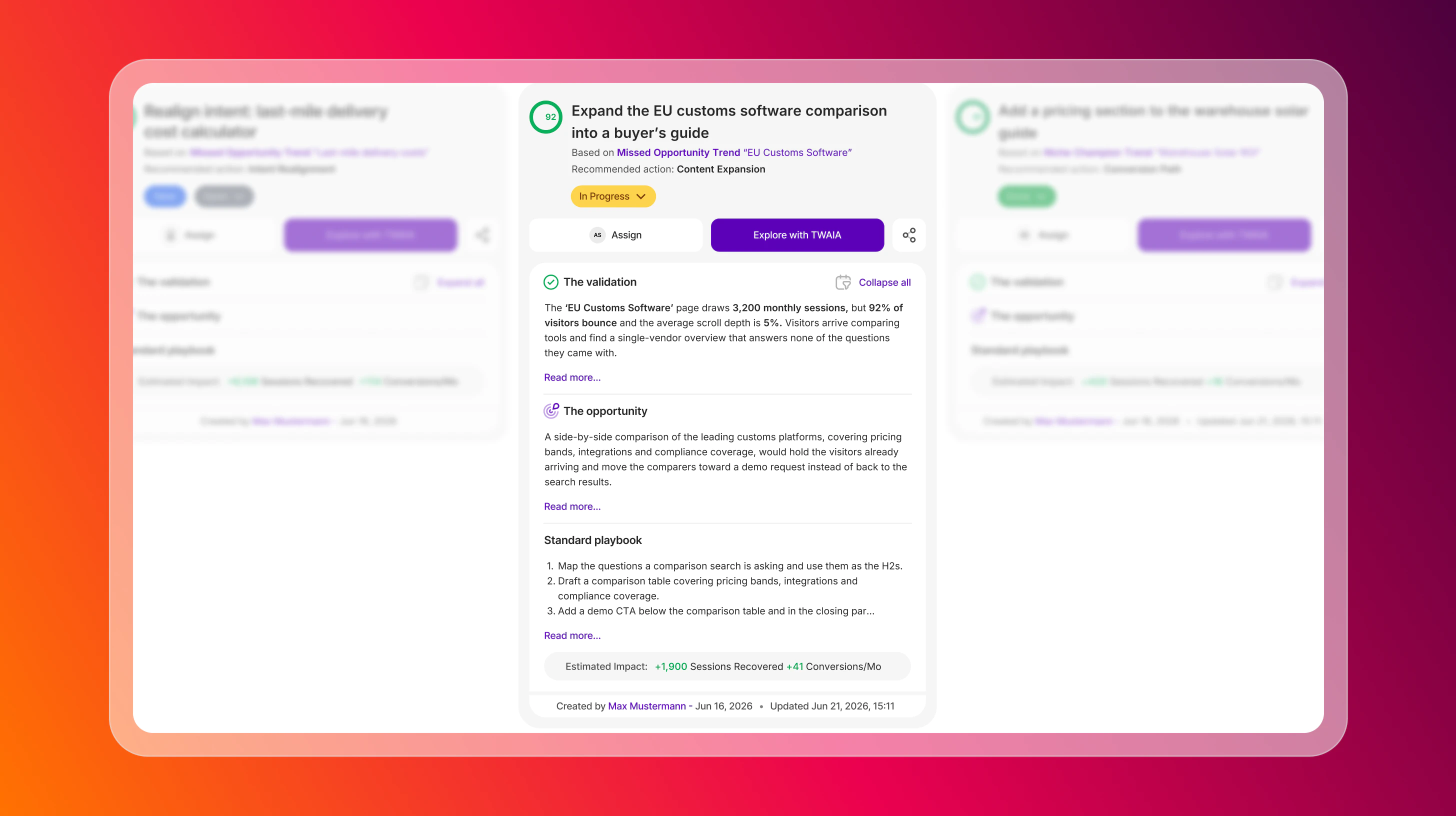
Every draft starts from a validated Content Opportunity: a topic your own visitors are already engaging with, scored on traffic, scroll depth and intent against your site's own baselines, with the evidence attached.
That is the difference. Any AI writing tool can put a human editor in the loop. None of them can tell you that a topic is worth writing because 3,200 of your own visitors came looking for it last month and left without an answer. A draft written to close a real gap in your own site, for the visitors who are already there, is not scaled content abuse, and no generic prompt can produce it. It is the helpful content Google says it wants, and only a tool that lives inside your analytics can make that claim.
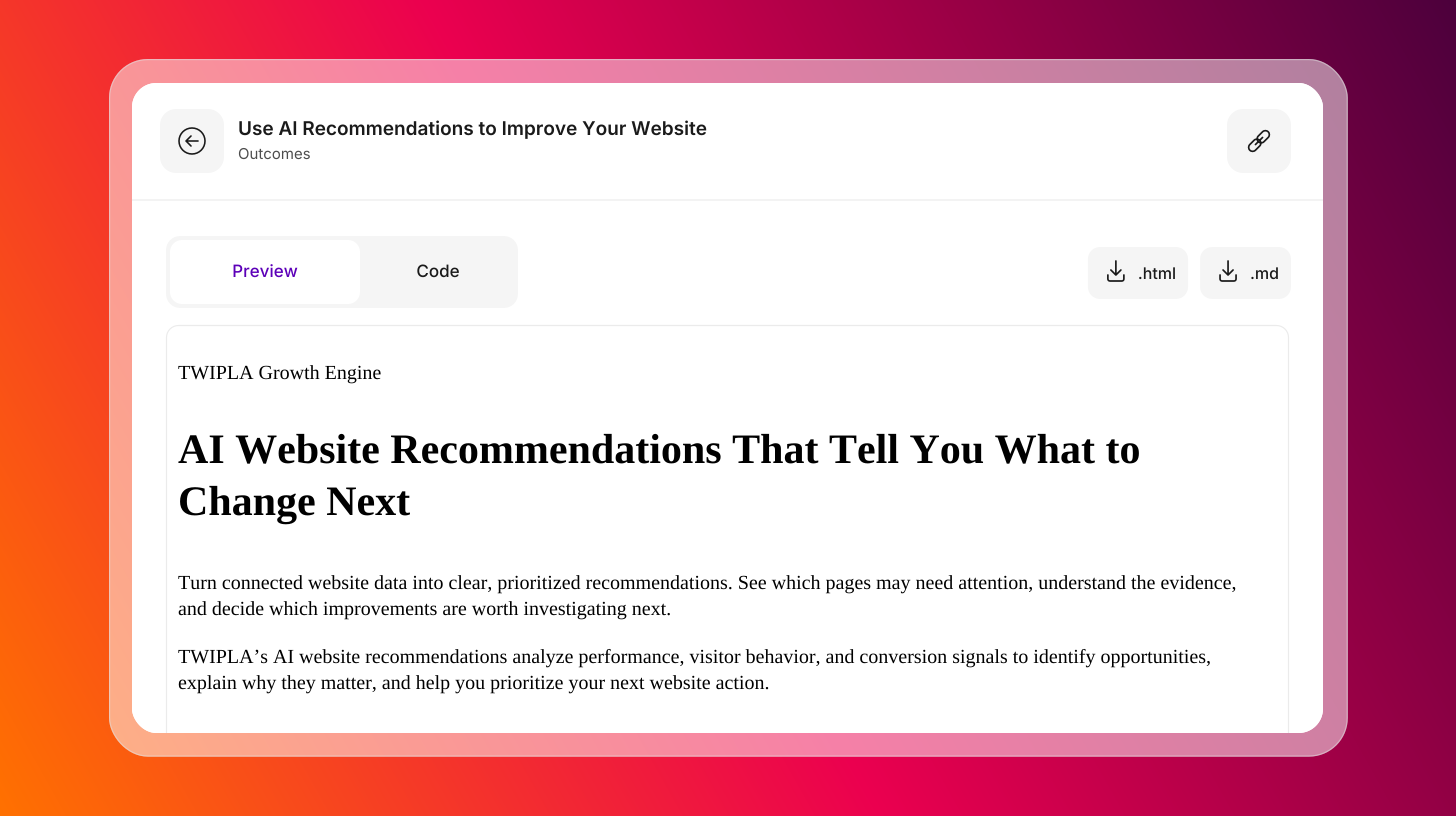
Then the human stays in charge, at every step, in the order the regulation wants. Every opportunity has an owner and a status, from New to In Progress to Done, so there is always a named person responsible for it. Nothing gets written until that person approves the playbook, and every step of it is marked to show whether TWAIA can do it, can start it, or needs a person. When TWAIA, the AI assistant built into TWIPLA, works through its share, the results (the rewritten page, the new meta title and description, the answer block, the edit list) open in the Content Editor, where the owner's job is to read the draft, check it, refine it and decide whether it goes out.
The assistant sits in the editor's sidebar to rewrite whatever you ask, and this is where the sequencing matters: use it to get the draft where you want it, then do your own final pass. The last substantive change to the piece should be a human one. That is not a workaround. It is what the exemption asks for, and the editor makes it the natural way to work.
What you publish alongside the piece is your call. If the topic is in scope and your policy is to label, the EU label goes at the top of the page. The workflow leaves that decision where it belongs: with the person whose name goes on the piece.
And the watermark? Marks degrade with editing, whichever provider applies them, so a draft written against your own data and substantively edited by a human carries far less of one than raw chatbot output. But the point is not to hide anything. By the time a piece leaves TWIPLA, it is your content, on your evidence, under your editorial responsibility, and that is what both the regulator and the search engine are asking for.
What this looks like for a legal team
For the people who will be asked to sign off:
The content is grounded in first-party behavioral data from your own website, not generated from a generic prompt. What leaves TWIPLA for drafting is aggregated website statistics and the page URLs, processed through the OpenAI API, which does not use API data for model training by default. Every piece has a named owner and passes through substantive human review in the editor before publication, with the human edit as the final step, which is the condition under which Article 50's disclosure duty for public-interest text does not apply. Where a label is required or chosen, the workflow supports placing it at the top of the piece in the EU format. And nothing in the process depends on defeating detection: the content is meant to be identifiable as yours.
That is a paragraph you can forward.
The compliance question, answered before it is asked
AI watermarks have arrived. So have the disclosure rules, with guidelines attached. Neither is a threat to a team that publishes content grounded in its own data and properly edited by a person. Both are a threat to a team that publishes raw chatbot output at scale.
The question nobody is asking yet is which of those two teams yours is. The good news is that the answer is a workflow decision, and you can make it this week.
Share article


Get Started for Free
Gain World-Class Insights & Offer Innovative Privacy & Security

You might also like




Read next



 31 December 2024 - by Simon Coulthard