Simon Coulthard October 16, 2026
The Content You're Missing Is Costing You More Than You Think

Somewhere in your website data right now, there is a topic your visitors care about more than you do.
They are arriving in numbers. They are reading. Some of them are scrolling all the way down, hunting for an answer your page does not quite give them, and then leaving. Nobody on your team has noticed, because nothing on your dashboard is red. Traffic is up. The page looks like a success.
It is not a success. It is a Missed Opportunity, and it has a price tag.
A Missed Opportunity is a topic on your website that attracts high traffic but low engagement or intent: visitors arrive in numbers, do not find what they came for, and leave without converting. It looks like a success on a traffic chart and is one of the most expensive gaps a content team can have.
TL;DR
The most reliable demand signal you have is what your own visitors already do on your site, and most teams never look at it because it is buried across hundreds of pages and weeks of history. A high-traffic page that visitors leave without converting can quietly cost thousands a month, and it never shows up as a loss. Growth Engine, TWIPLA's content tool, scores every topic on your site on traffic, engagement and intent, flags the ones that are leaking, puts a number on what each is worth, hands you a playbook, and drafts the fix. The cost of not knowing is real money. The cost of finding out is now close to zero.
Subscribe to the Newsletter →
Stay up to date with TWIPLA. Get product updates, practical insights, and industry news delivered to your inbox.
Demand you already have, and are not serving
Most content planning starts from the outside in. You look at keyword tools, competitor blogs, industry trends, and you make an educated guess about what to write next. Then you wait weeks or even months to find out whether the guess was right.
But your website is already telling you what people want. Every session is a small vote. Which topics pull visitors in. Which ones hold their attention. Which ones lead to a signup, a purchase, a second page. This is the most reliable demand signal a business can have, because it comes from your actual audience behaving naturally, not from an estimate of what strangers might search for.
The problem is that the signal is buried. It lives across hundreds of pages, dozens of metrics and weeks of history. Spotting it means working out what "normal" looks like for your site, then finding the topics that break the pattern. Almost nobody does this by hand, so the demand goes unserved, month after month.
What a Missed Opportunity actually costs
Let's make it concrete.
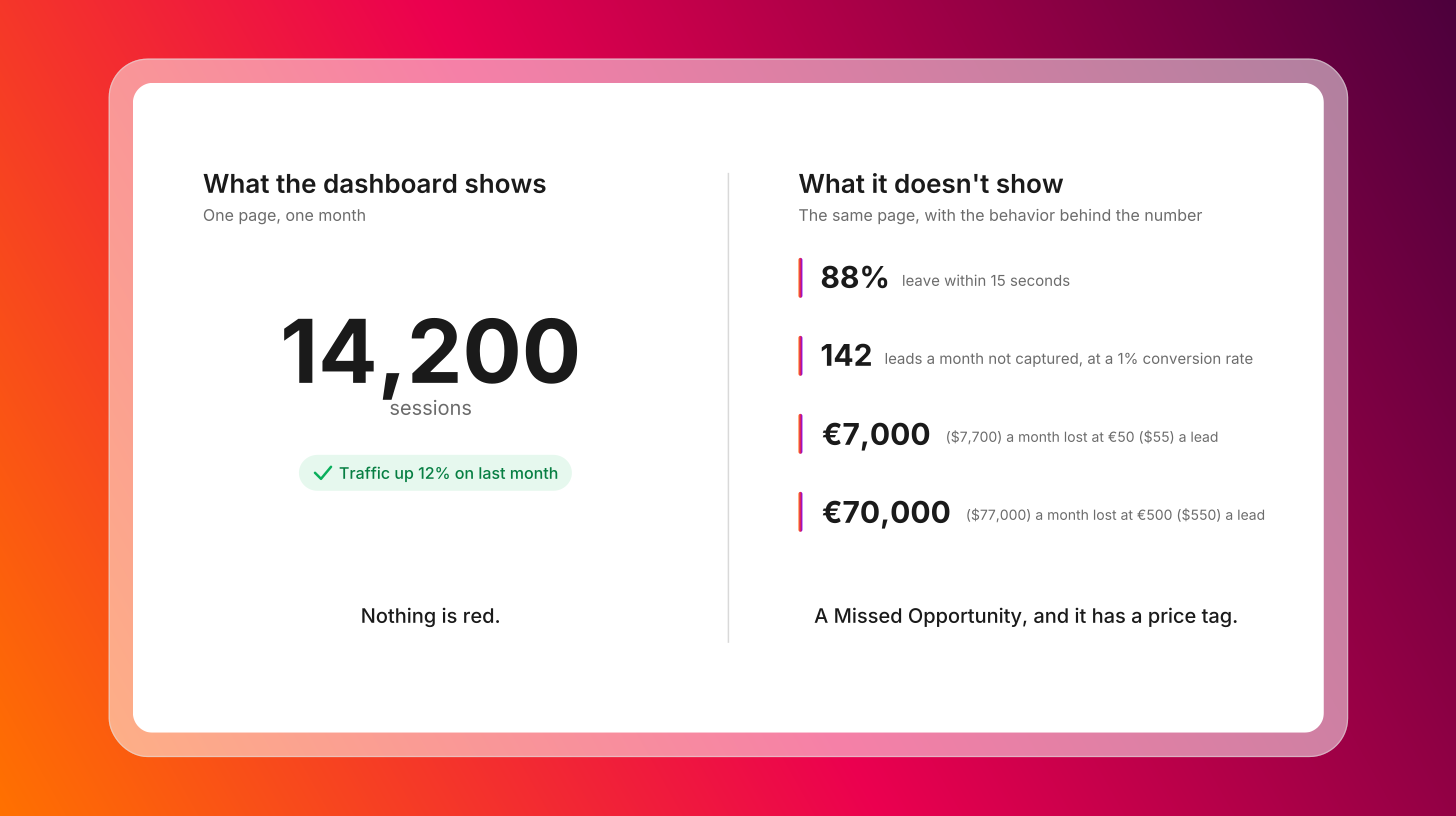
Say a page on your site about last-mile delivery costs brings in 14,200 sessions a month. That is high traffic, which is why it never looked like a problem. But 88% of those visitors bounce, the average time on page is 15 seconds, and hardly anyone converts. Visitors are showing up with a question, not finding the answer, and leaving.
The numbers that follow are an illustration, not a measurement, so swap in your own. If just 1% of those visitors had converted because the content answered what they came for, that is 142 leads a month you are not getting. If a lead is worth €50 ($55) to your business, that single page is costing you about €7,000 ($7,700) a month. If a lead is worth €500 ($550), it is €70,000 ($77,000).
Now multiply that by however many topics on your site are in the same state. Most sites have several. Because they look like successes on a traffic chart, they can stay that way for years.
This is the economics of not acting. The cost is invisible precisely because it never shows up as a loss. It shows up as revenue that quietly never happened.
Finding it used to cost a fortune too
Here is why the demand stays unserved: until now, finding it was expensive in its own right.
To do it manually, someone has to export your traffic data, work out a baseline for every topic on your site, cross-reference engagement against conversion, find the topics that break the pattern, and write up what to do about it. That is a data analyst's job, and it takes days each time. A junior analyst costs around €4,000 to €5,000 a month (roughly $4,500 to $5,500). An SEO agency, more. So most teams do it once a year, if at all, and the picture is out of date before anyone acts on it.
The keyword tools most marketers already pay for don't help much here, because they are looking in the wrong place. They are built around third-party estimates of what strangers might search for, not around what the people already on your site are doing. They were never designed to tell you that 88% of your visitors left a page in 15 seconds. That number lives in your own analytics, and it is the one that shows where the money is leaking.
So the leak persists. Not because nobody cares, but because the cost of finding it has always been high enough to put off.
Now finding it costs almost nothing
Growth Engine, TWIPLA's content tool, exists to make that invisible cost visible, and then to recover it.
It groups every page on your website into topics and scores each one on three things:
- how much traffic it gets,
- how deeply visitors engage with it (scroll depth, a real behavioral signal rather than a raw count),
- and how much intent it shows (conversion rate, or continuation deeper into your site where no conversion is set up).
Each score is compared against your own site's averages, not an industry benchmark that has nothing to do with your audience. It refreshes as often as every three hours, whether or not anyone is logged in.
Topics are then sorted into categories that tell you what to do next:
- Golden Keywords (your proven winners),
- Niche Champions (small audiences with strong signal),
- Core Pillars (your steady foundations),
- and Missed Opportunities (high traffic, low engagement or intent).
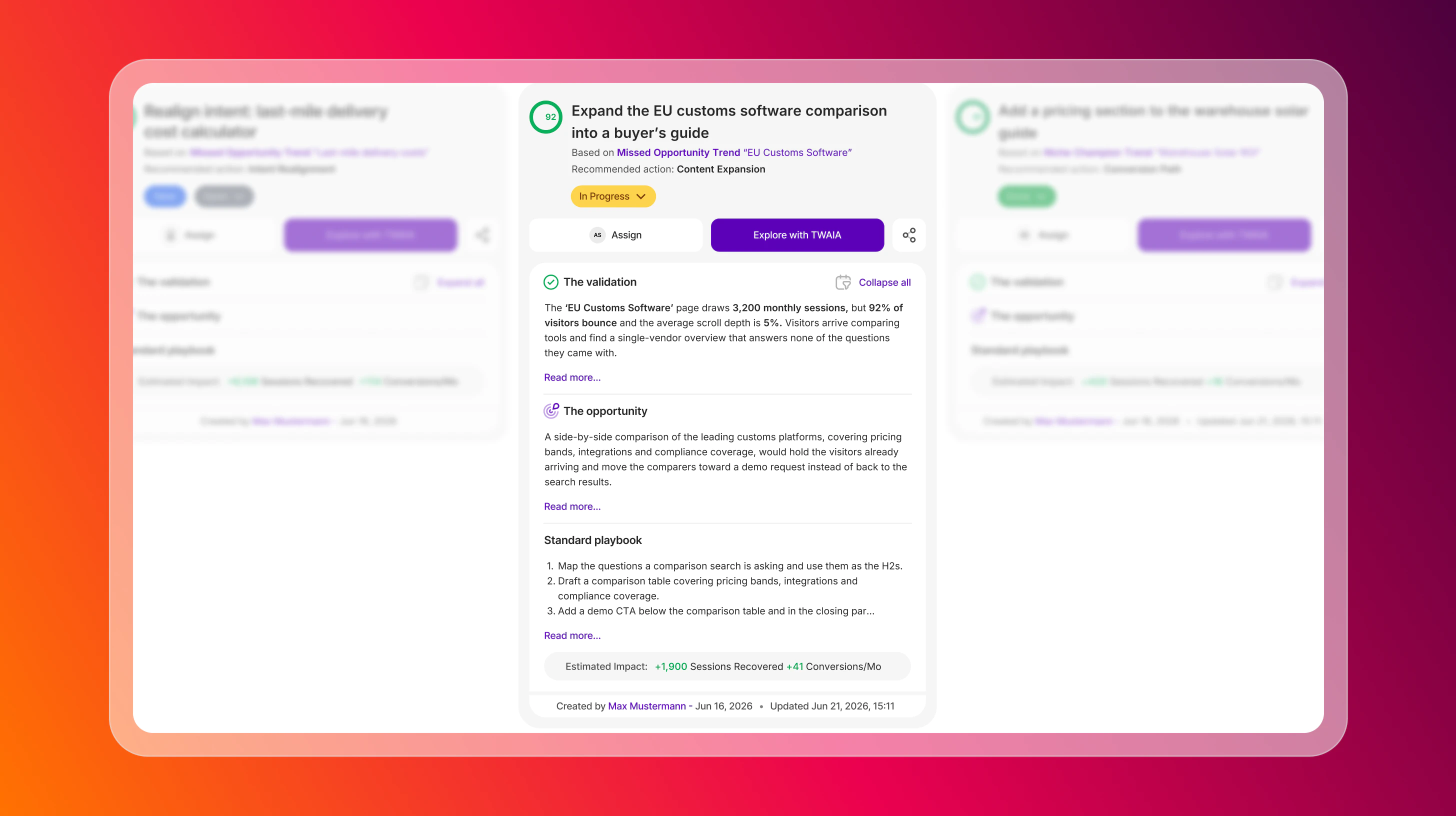
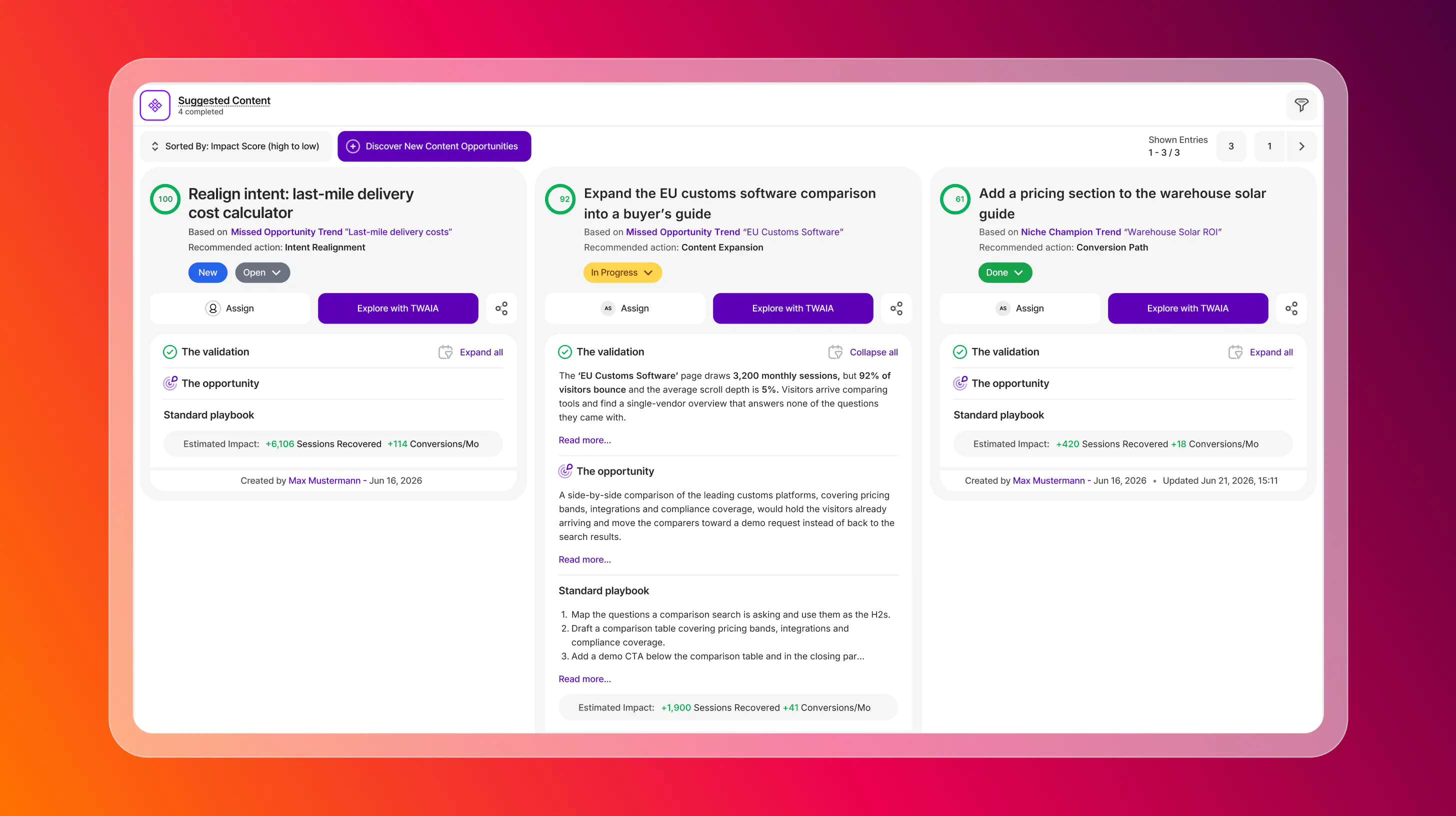
From those, and from Google trends that fit your site, Growth Engine writes up Content Opportunities: what the data shows, why it matters, a playbook to follow, and the projected lift in sessions and conversions. The list arrives ranked by impact, so you start with the one that pays off most. Each one can be assigned to a colleague, carry your own tasks next to the playbook, and be tracked from New to Done.
That last-mile delivery page is exactly what this looks like in practice. Growth Engine flags it as a Missed Opportunity, explains why in plain language, hands you a playbook (rewrite the headline and opening paragraph to answer the core question above the fold, cut the background), and projects the return: around 6,100 sessions recovered and 114 extra conversions a month.
It can do this because it sits inside a complete analytics solution with 15 interconnected tools. The scroll depth, conversions and visitor journeys it scores are the same data that already powers TWIPLA's heatmaps, session recordings and conversion tracking. And when Growth Engine flags a Missed Opportunity, a session recording or heatmap of that page shows you exactly where visitors give up, so you know what to fix before you write a word.
And it collects all of that without cookies and without a consent banner. TWIPLA tracks visitor behavior cookielessly, in a privacy-first mode that needs no opt-in, and your tracking data is stored in Germany. So you get the depth of behavioral data that a keyword tool cannot see at all, and you get it from every visitor, not just the ones who clicked "accept".
Nobody ran a report. Nobody wrote a prompt. The analysis happened in the background, and you get the conclusion.
The numbers on the other side
Here is where the economics flip.
The analyst's days of work become a list that is waiting for you when you log in. The annual audit becomes a picture that is never more than a few hours old. And the one Missed Opportunity you might have caught by hand becomes every Missed Opportunity on your site, ranked by what each is worth.
Go back to that page. Growth Engine's own projection for the fix is 114 extra conversions a month, which at €50 ($55) a lead is around €5,700 ($6,300) a month recovered from a single page, for a few minutes of reading a card and approving a playbook. Every further opportunity you act on is pure margin, and most sites have several pages in the same state. And the more history your tracking code has, the sharper the opportunities get.
Then there is the time. Marketers lose hours every week staring at dashboards that report what happened without saying what to do about it. Standard analytics tell you about yesterday. Content Opportunities tell you what to do today, in a playbook you can hand to your team on Monday morning.
Every week between spotting and publishing is revenue lost
Finding the opportunity is half the value. The other half is acting on it before the demand moves on, and this is where most content processes leak money: the brief that sits in a backlog, the draft that waits for a writer, the article that takes a month to ship.
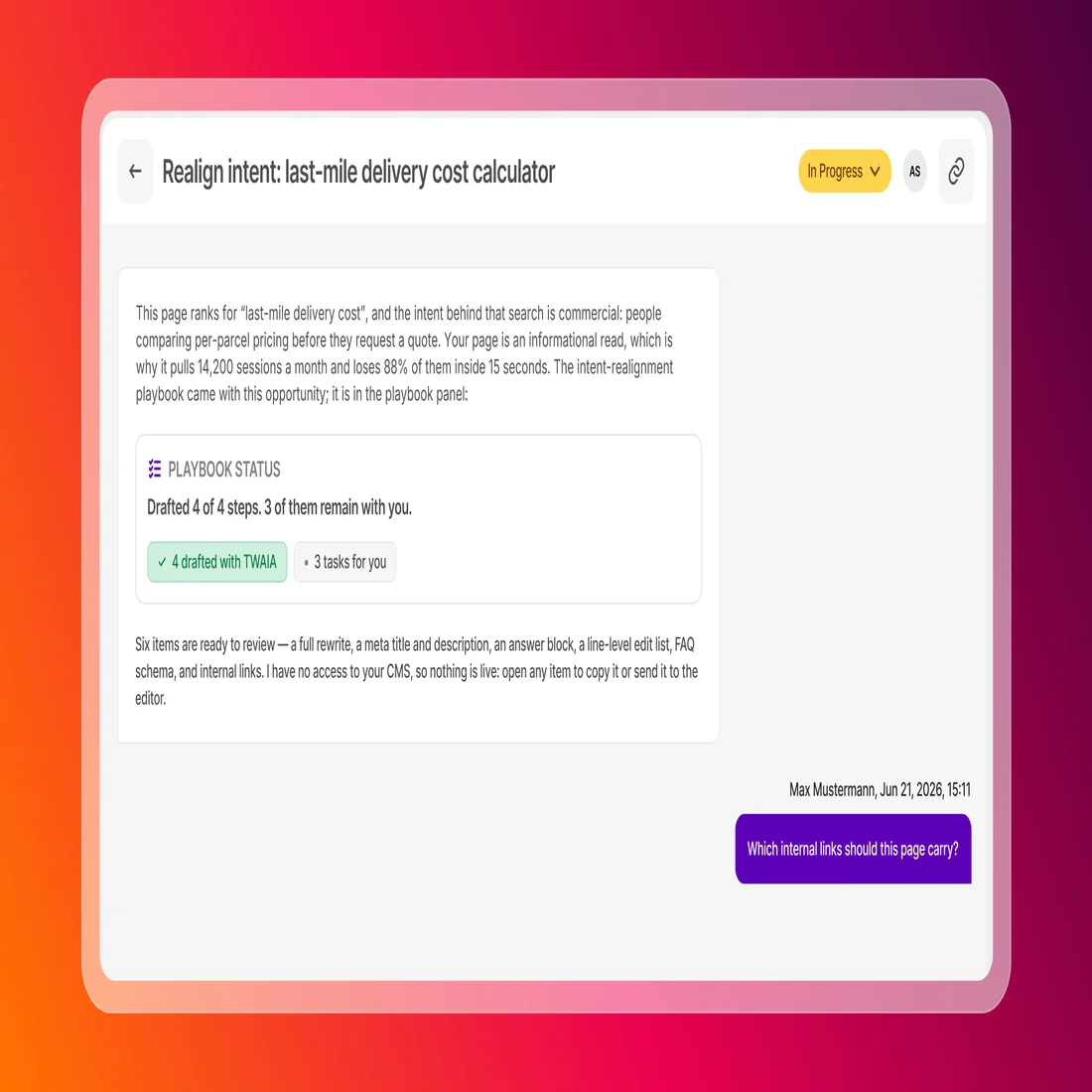
Growth Engine closes that gap. Open an opportunity and you are working with TWAIA, the AI assistant built into TWIPLA, which already knows the topic, the numbers behind it and the playbook for closing it. Every step of the playbook shows whether TWAIA can do it for you, get it started, or needs a person. Approve it and TWAIA works through its share: the rewritten page, the new meta title and description, the answer block for AI search, the line-by-line edit list or a list of UX friction fixes. No prompt to write, no context to explain.
Each draft opens in the editor, follows a content profile you set up once (tone of voice, target audience, sector, language, length, calls to action, image placeholders), and exports as .md or .html to wherever you publish. You stay the editor: read it, refine it, publish when you are happy. And when the idea is yours rather than the data's, Custom Content Studio lets you brief TWAIA on any topic and get the same draft in the same editor.
The distance between spotting a Missed Opportunity and closing it shrinks from weeks to an afternoon. At €7,000 ($7,700) a month per topic, that speed is worth real money.
The cost of waiting
Every month a Missed Opportunity sits unaddressed, the revenue it represents is gone for good. The visitors who came looking for an answer and left are not coming back to check whether you fixed it.
The demand is already on your site. The question is only whether you find out about it now, or keep paying for not knowing.
Share article


Get Started for Free
Gain World-Class Insights & Offer Innovative Privacy & Security

You might also like




 18 April 2023 - by Simon Coulthard