






TWIPLA GDPR/ePrivacy Statement: Maximum Privacy Mode (MPM)
Introduction
All the mentioned implications, explanations and details that follow only refer to the so-called Maximum Privacy Mode (MPM), which is intended to be run in a consentless environment.
This statement is aligned with the GDPR (General Data Protection Regulation) and the ePrivacy Directive from the European Union, and also takes into account other privacy laws worldwide, including the CCPA (California, USA), LGPD (Brazil), FADP (Switzerland), and others.
As the GDPR and the ePrivacy Directive have been adopted as a reference framework by many non-EU countries, and because both place a strong emphasis on protecting Personally Identifiable Information (PII), we use them as the blueprint for implementing privacy-focused tracking and analytics solutions.
Since the introduction of the GDPR in 2018, the IP address has meanwhile also been identified as potential PII under certain circumstances which is - of course - also reflected in Maximum Privacy Mode (MPM) functionality.
General Ruling of GDPR and ePrivacy
In order to simplify the legal assessment of these two major privacy regulations, we usually differentiate between the requirements of each in the following manner:
GDPR
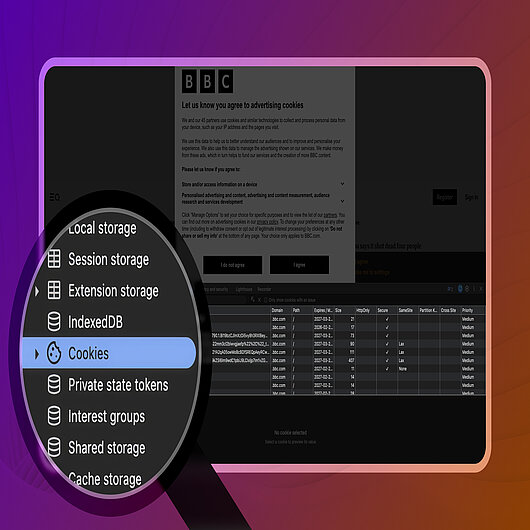
The GDPR mainly relates to the storage of any type of information on the user’s device.
- The law generally permits this without requiring consent when the stored data is technically necessary. From a format perspective, it does not matter whether data is stored in cookies, Local Storage, Session Storage, or any other current or future storage mechanisms on the end user’s device.
- What does “technically necessary” mean?
- The simple question to post would be here: Can you remove the stored information (like the cookie) from the browser storage and the website would still be functional? If the answer is yes, the cookie (or similar) is not technically necessary and has to be consented to upfront.
- The same applies to the tracking cookies used to reidentify visitors for advertising purposes.
- A session cookie used to keep a user logged in is, however, technically necessary.
- The simple question to post would be here: Can you remove the stored information (like the cookie) from the browser storage and the website would still be functional? If the answer is yes, the cookie (or similar) is not technically necessary and has to be consented to upfront.
- What does “technically necessary” mean?
- (Visitor) Profiling according to GDPR is also restricted in our “Maximum Privacy Mode (MPM)” which results in the inexistence and inaccessibility of features like showing the history of visited pages and other similar insights.
ePrivacy
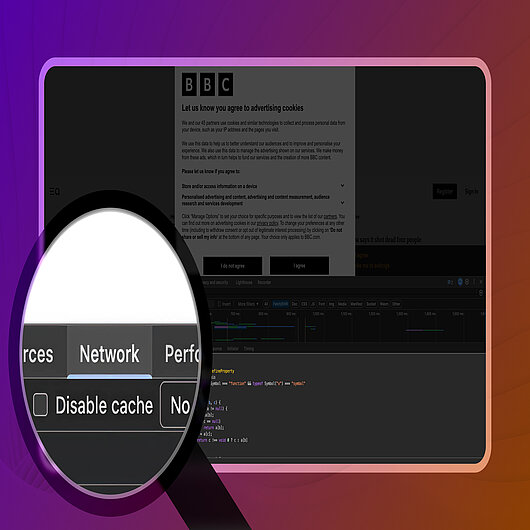
The ePrivacy Directive focuses on the retrieval of information that is [already] stored on the end user’s device (like cookies, and any other technical aspects/information of the browser itself for generating digital fingerprints).
- This directive is set up to control the potential retrieval of information that is already stored on the end user’s device.
- Informed consent upfront is needed for any information which already existed on the end user’s device, such as:
- screen resolution
- installed fonts
- color depth
- and other similar ones
- No consent is needed for information that is not retrieved from existing storage on the end user’s device and is transmitted automatically as a part of normal communication. Examples for some of this information would be:
- All information transmitted as part of the HTTP request, provided no additional legal assessment applies, as is the case for the processing of IP addresses, such as the:
- User Agent
- Language Preferences
- Requested URL
- Referring URL
- Screen resolution (if not acquired via usual javascript methods).
- x-y mouse coordinates while browsing a page.
- All information transmitted as part of the HTTP request, provided no additional legal assessment applies, as is the case for the processing of IP addresses, such as the:
- Informed consent upfront is needed for any information which already existed on the end user’s device, such as:
Maximum Privacy Mode (MPM)
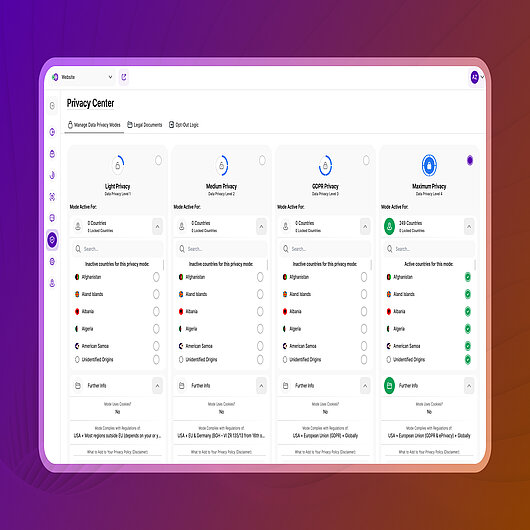
The Maximum Privacy Mode was built to be run in a consentless, non-cookie, and ePrivacy-compliant way, making analytics and statistics accessible again without the need to place a consent or cookie banner on your page.
How do we achieve this?
As this approach naturally raises many questions, we have prepared a comprehensive document that hopefully answers all your potential questions
→ https://www.twipla.com/en/why-us/maximum-data-privacy-mode
Maximum Privacy Mode, in a single sentence
If you asked me to summarize the Maximum Privacy Mode (MPM) in a single sentence only, I would answer the following →
“TWIPLA does not store anything on the device and removes potential profiling aspects (GDPR), nor does it request any information from the device that already exists there (ePrivacy/TDDDG §25).” (Alexander Veit, CEO of TWIPLA)
The 3 other Privacy Modes offered by TWIPLA
Besides the Maximum Privacy Mode (MPM), TWIPLA also offers three other privacy modes which usually require informed consent before tracking and analytics services are executed.
Light Privacy
This data acquisition mode comes with no restrictions and, depending on the location of the website visitor and/or the website owner, most likely requires informed consent upfront. In some countries with less strict legislation in place, it may also be possible to run this mode without consent. Please ensure you consult with relevant, informed personnel to support you in making an appropriate decision in this case. This mode uses fingerprinting.
Basic Privacy
Same as Light Privacy, but the IP address is not stored and is not accessible.
GDPR Privacy
Same as Basic Privacy, but potential profiling aspects under GDPR are removed and are not accessible, such as access to the visitor’s visited pages history.
Opt-out functionality
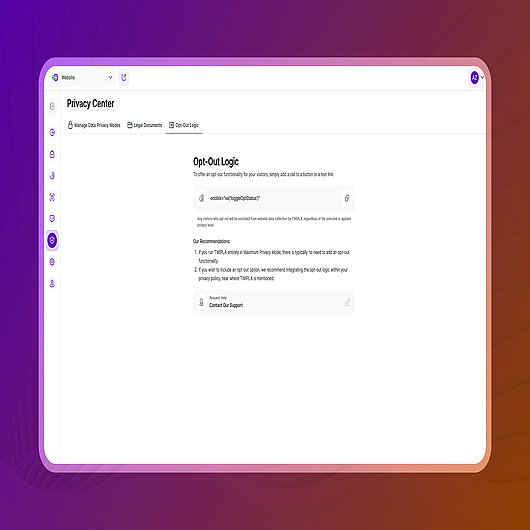
TWIPLA offers an opt-out functionality that can be provided to your website visitors if required or if you choose to do so → https://www.twipla.com/en/support/all-about-features/privacy-center#c108628
Hosting
All data storage and processing are carried out in data centers operated by HETZNER. The so-called analytics cluster was built and is maintained by us within HETZNER’s data center located in Falkenstein, Saxonia.
You can find a comprehensive article explaining why we chose HETZNER here
→ https://www.twipla.com/en/blog/twipla-and-data-storage-why-we-use-hetzner-in-germany
Content Delivery Network (CDN)
TWIPLA maintains its own Content Delivery Network (CDN) to accelerate loading times and improve processing performance. The entire CDN was built using infrastructure from HETZNER, OVH Cloud, and Hostinger. All providers are European entities and are not subject to the US Cloud Act.
You can find a comprehensive article about our CDN here
→ https://www.twipla.com/en/blog/content-delivery-network
Local Services
We use additional local services, such as MaxMind’s GeoIP data, to resolve IP addresses to latitude and longitude information and show the approximate location of visitors to your page. We do not use any externally hosted services for this purpose.
Data Processing Agreement (DPA)
We provide a comprehensive Data Processing Agreement (DPA) as a standard part of our privacy strategy. The DPA transparently lists all subprocessors involved (currently four).
You can review our DPA here
→ https://www.twipla.com/en/support/legal-data-privacy-certificates/standard-integration/data-processing-agreement
