Consentless website analytics by default
Consentless mode, explained
TWIPLA’s consentless mode is called Maximum Privacy Mode. It is the default, and it is what lets TWIPLA run without a cookie banner. Below is what it does and how TWIPLA justifies it legally.
Read the Data Processing AgreementHow visitors are counted
Instead of a cookie, TWIPLA recognizes visitors with a hash of their IP address and user agent. This hash works as a pseudonymous visitor identifier and stays the same as long as the visitor’s IP address and browser stay the same.
Unique visitor numbers are therefore approximate. Visitors who share an IP address and browser count as one, and a visitor whose IP address changes counts as new.
Because the hash can in principle be linked back to an IP address, we treat it as pseudonymous personal data under the GDPR, not as anonymous data.
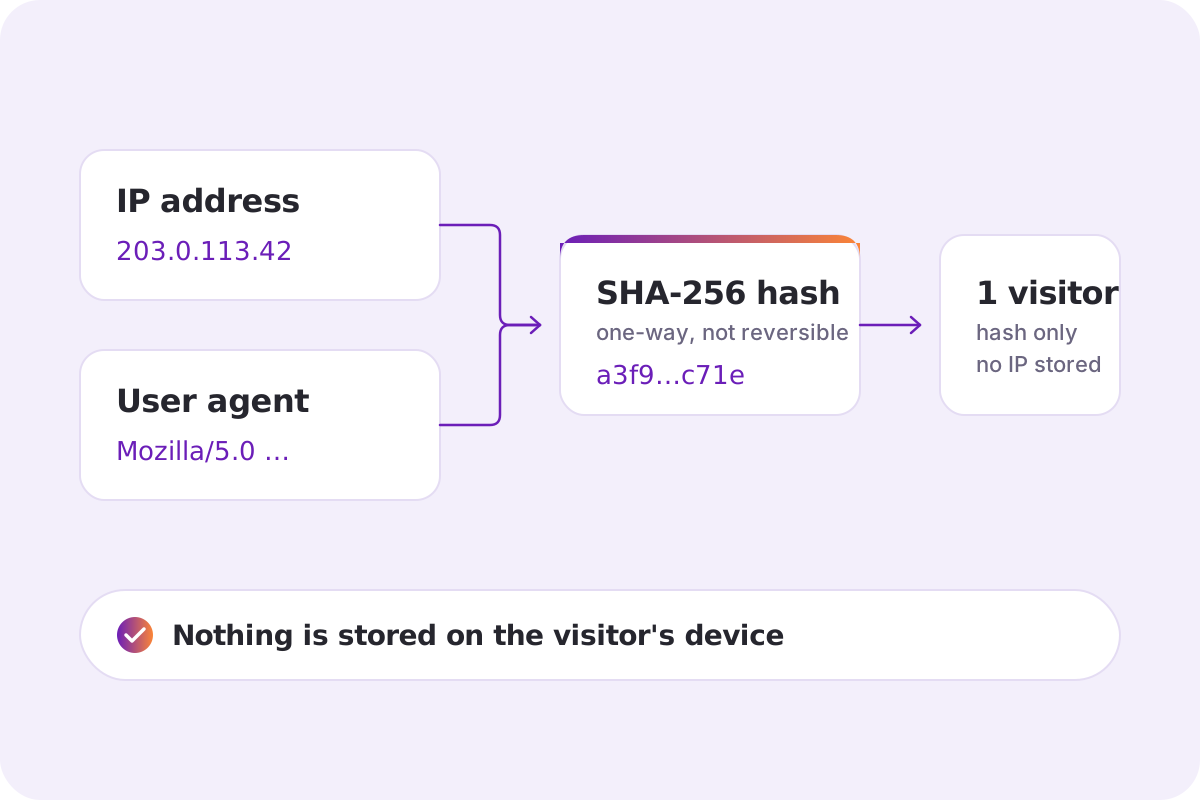
How it works
Maximum Privacy Mode uses only what a browser sends with every ordinary page request. It stores nothing on the device and creates no fingerprint.
| Area | What happens in Maximum Privacy Mode |
|---|---|
Cookies, Local Storage, Session Storage | None are set or read. |
Fingerprinting | No fingerprint is computed. Fonts, color depth, installed plugins and similar device properties are not queried. |
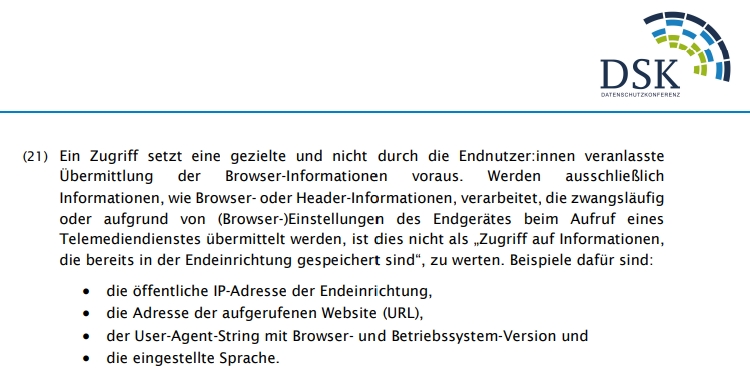
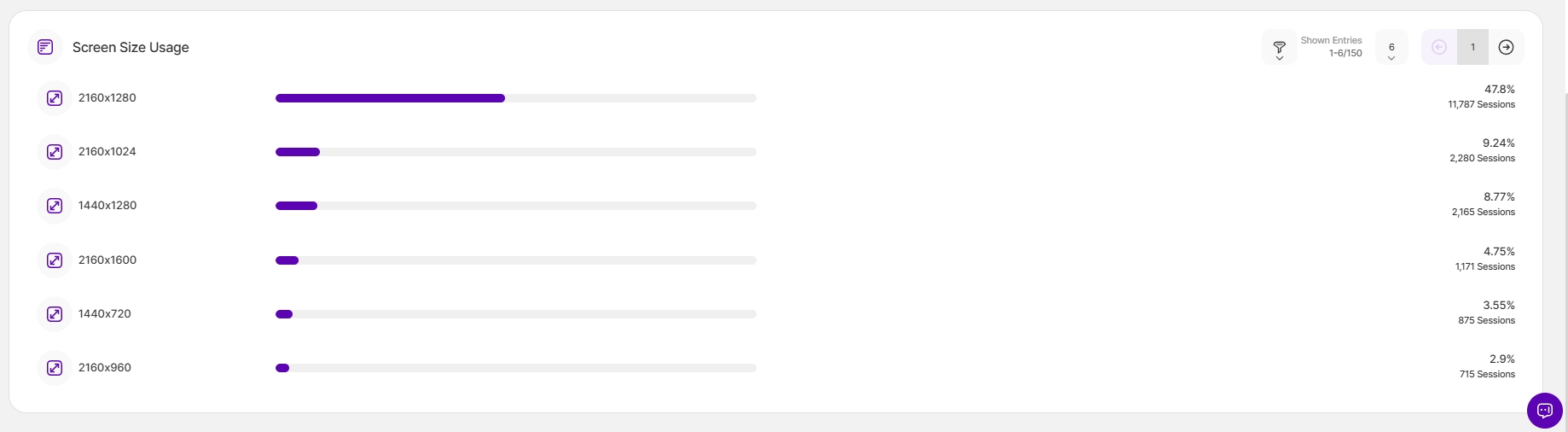
Data used | Information the browser sends with every page request: user agent, language preference, requested URL, referring URL. |
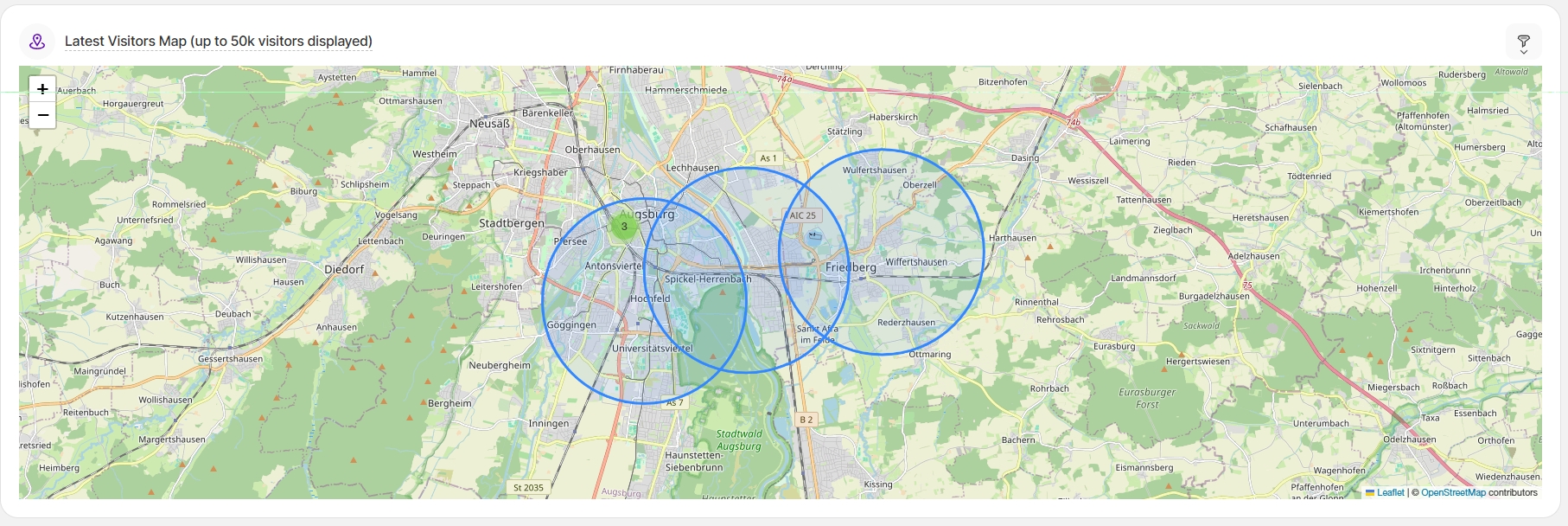
IP address | Used in memory for geolocation (approximate city/region via a locally hosted MaxMind GeoIP database) and company identification, then discarded. The IP address is never stored. |
Visitor recognition | The server computes a SHA-256 hash of the IP address and user agent. Only this hash is stored. See “How visitors are counted” above. |
Profiling | The page history of individual visitors is not available. Only aggregated data is processed. |
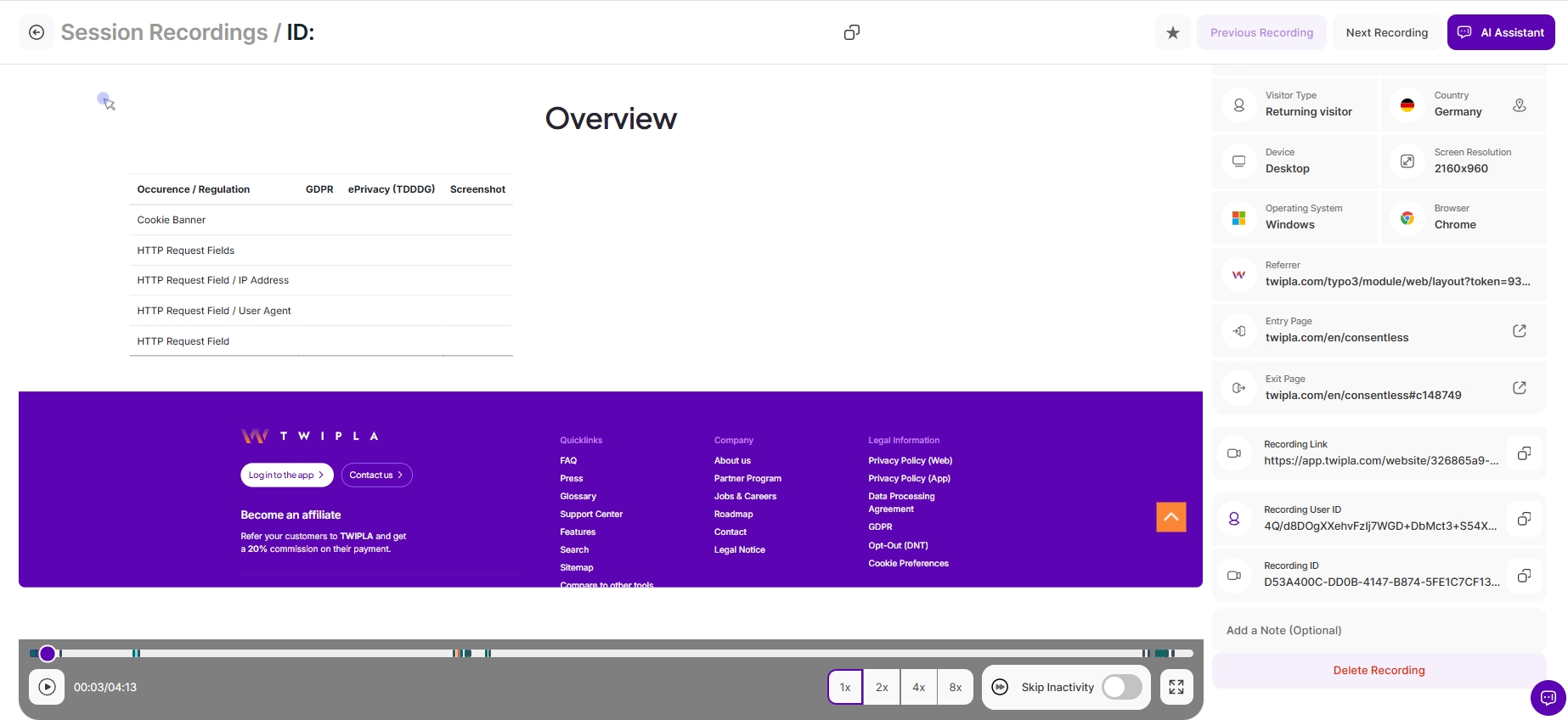
Heatmaps and session recordings | Available. Form inputs are masked in recordings. Mouse movements and interactions are recorded in the context of § 25 TDDDG (ePrivacy Directive). |
The legal reasoning
Two separate sets of rules apply to website analytics in the EU: device access rules (ePrivacy) and data protection rules (GDPR). Maximum Privacy Mode (MPM) was developed, with legal review, to avoid the consent requirement under the relevant rules. It keeps the processing under the second minimal.
“Consentless” means no consent banner is needed to run TWIPLA in Maximum Privacy Mode. It does not mean data protection law stops applying.
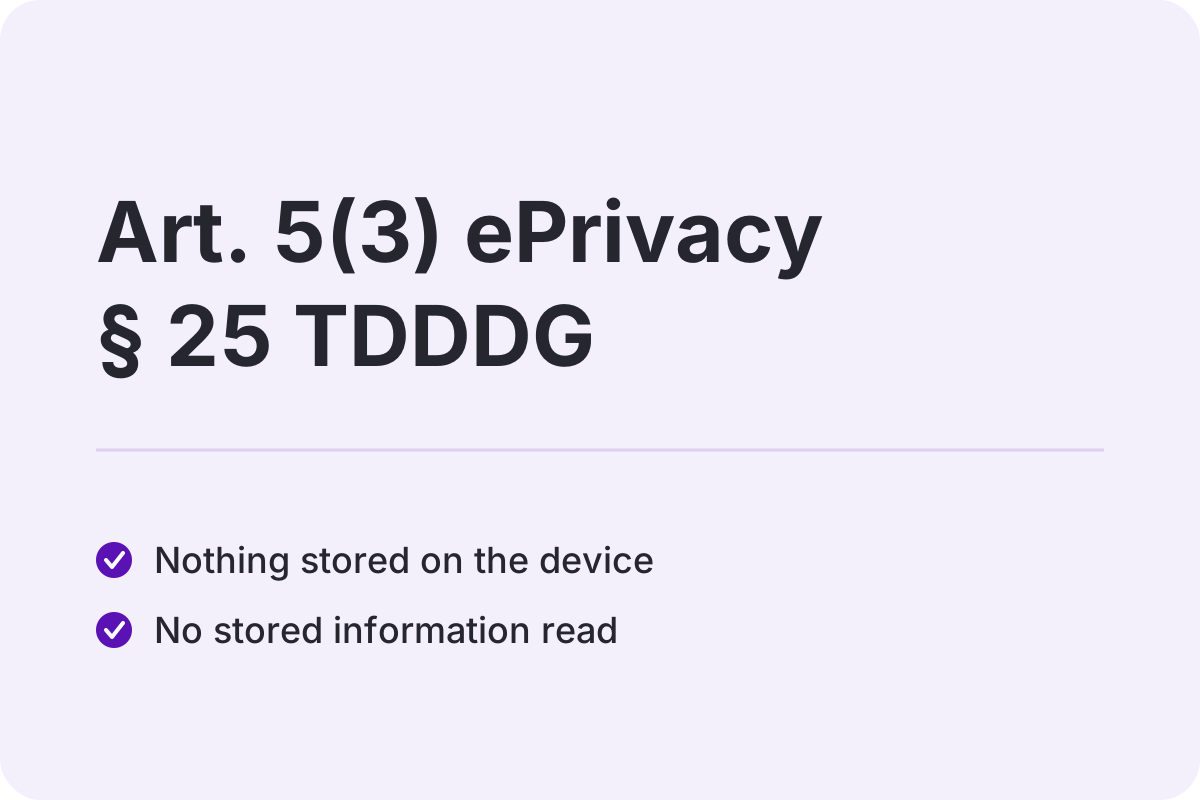
1. Device access
Art. 5(3) ePrivacy Directive and § 25 TDDDG (Germany)
The ePrivacy Directive Art. 5(3) and Germany’s TDDDG § 25 require consent when information already stored on the user’s end device (the website visitor’s browser) is to be accessed, for example through a JavaScript query. These rules apply whether or not personal data is involved. Conversely, no consent is required to access information that is not already stored there.
Maximum Privacy Mode reads no information already stored on the device and no device properties. It relies only on information the browser sends with every request anyway, and on information generated at runtime. On that basis, consent under these rules is not required.
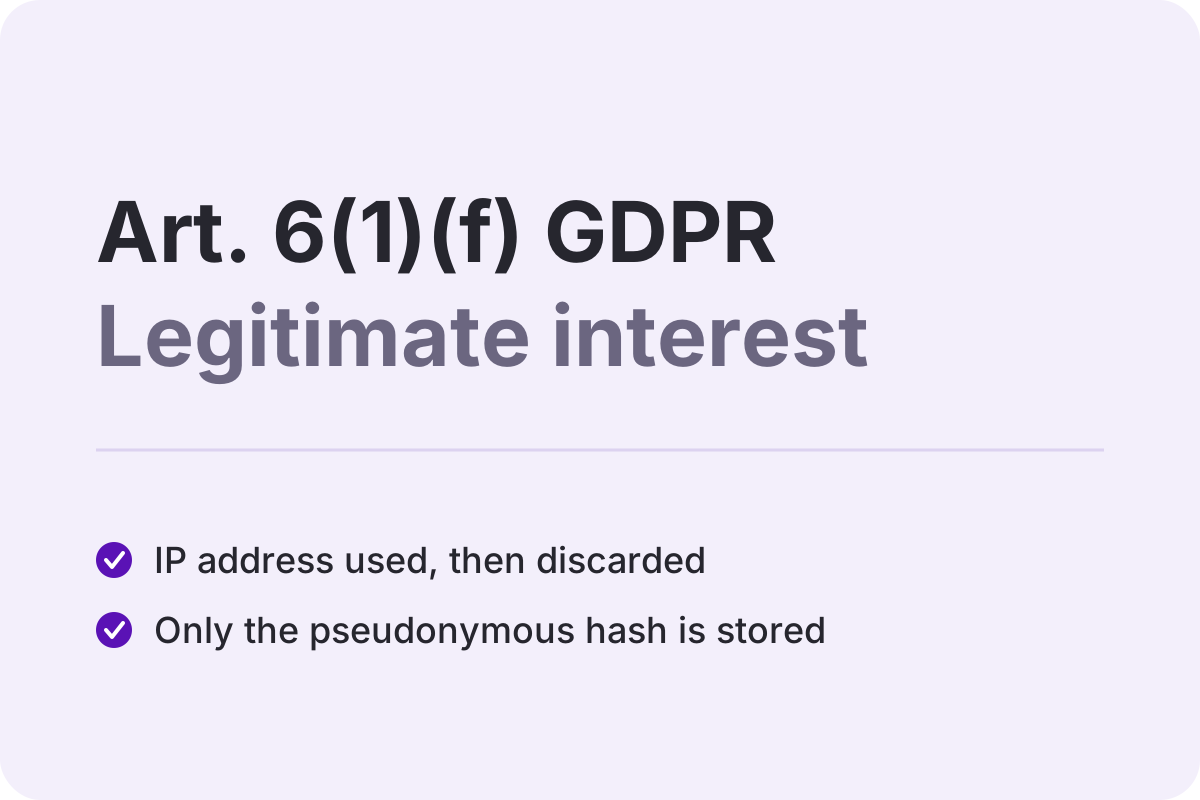
2. Processing of personal data
General Data Protection Regulation (EU)
The GDPR governs what happens to personal data that may be received, processed and stored. In Maximum Privacy Mode, this covers two things:
- the IP address, processed briefly in memory and then discarded
- the pseudonymous visitor hash
The legal basis for this processing is legitimate interest under Art. 6(1)(f) GDPR. The interest is understanding how a website is used, without profiling individuals. No consent is required for this basis. Transparency and the right to object still apply, as with any processing.
Privacy modes, opt-out and hosting
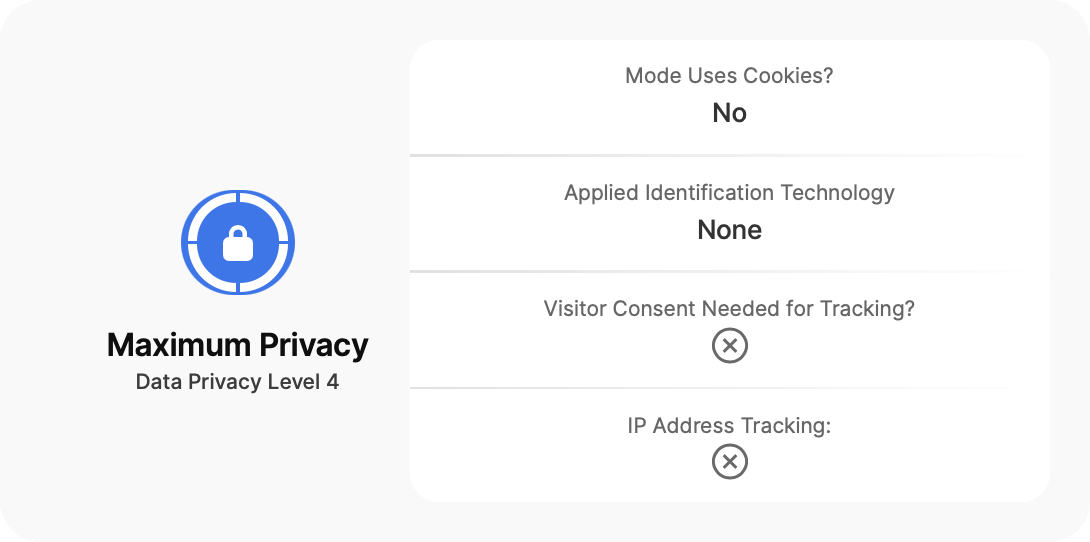
Maximum Privacy Mode is one of four available modes, and the most privacy-friendly of the four. The other three collect more detailed data and usually require consent. Whichever mode you choose, you can offer visitors an opt-out linked from your privacy policy. All data collected by TWIPLA is hosted exclusively in Germany.
| Mode | Fingerprinting | IP address stored | Visitor page history | Consent (usually) required |
|---|---|---|---|---|
Maximum Privacy | No | No | No | No |
GDPR Privacy | Yes | No | No | Yes |
Medium Privacy | Yes | No | Yes | Yes |
Light Privacy | Yes | Yes | Yes | Yes |
Detailed breakdown: GDPR and ePrivacy Directive (TDDDG)
Your checklist as a website operator
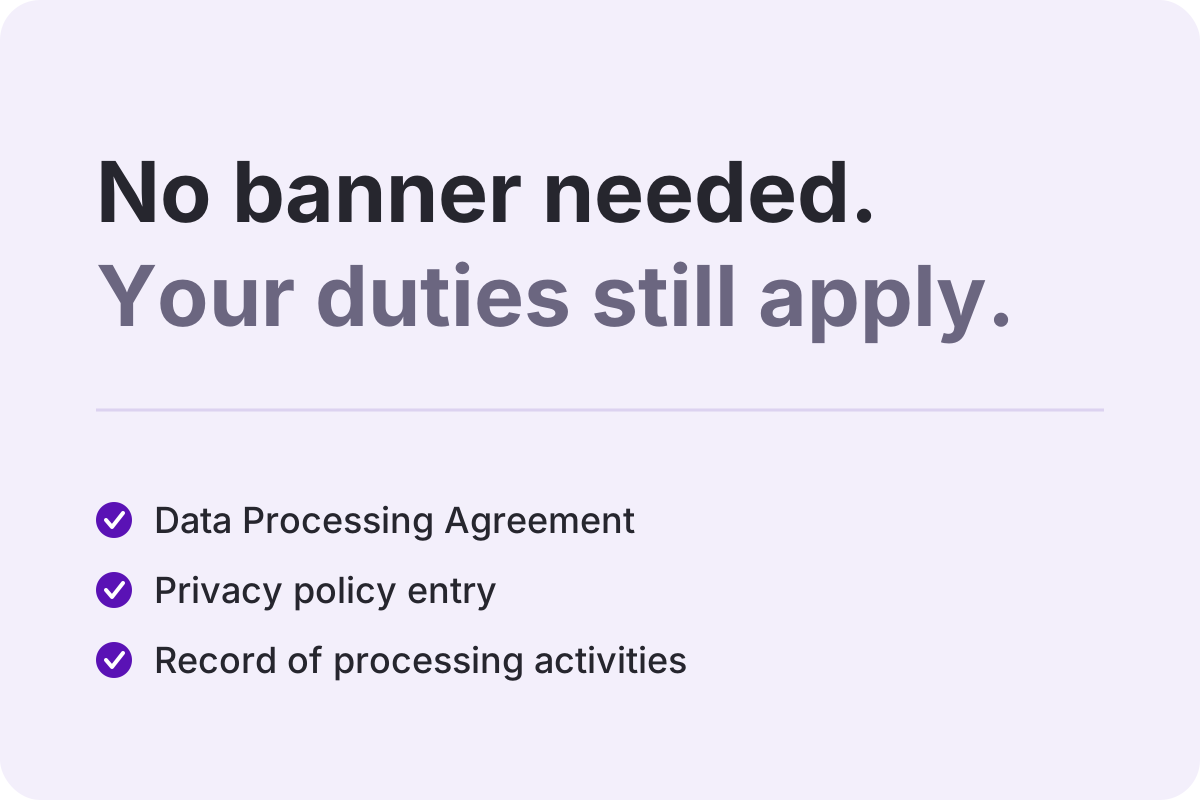
Maximum Privacy Mode removes the need for a consent banner for TWIPLA. It does not remove your other obligations as controller:
- Sign TWIPLA's Data Processing Agreement.
- Describe TWIPLA in your privacy policy: the legal basis (Art. 6(1)(f) GDPR), brief IP processing, the visitor hash, the features you use, and hosting in Germany.
- If you use the dual tracking code, say plainly that visitors who decline cookies are still counted without cookies.
- Optionally, enable the opt-out and link it from your privacy policy.
- Record the processing in your record of processing activities, including a short legitimate-interest assessment.
Legal consultation
TWIPLA is advised by Reed Smith Munich, in particular the Privacy, AI & Data Security Team led by Dr. Andreas Splittgerber. If you have any legal questions or are interested in our solution, contact us at consentless@twipla.com. We’re happy to help!